
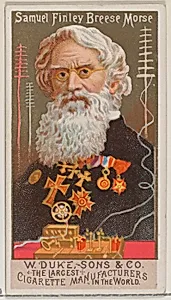
Samuel Finley Breese Morse, from the series Great Americans (N76) for Duke brand cigarettes
Medium
Commercial color lithograph
Dimensions
Sheet: 2 3/4 × 1 1/2 in. (7 × 3.8 cm)
Classification
Prints|Ephemera
Department
Drawings and Prints
Museum
Metropolitan Museum of Art, New York, NY
Credit
The Jefferson R. Burdick Collection, Gift of Jefferson R. Burdick
Accession Number
63.350.204.76.35
Rights
Public Domain
Tags
Art Historical Context
In the late 19th century, American tobacco companies like W. Duke, Sons & Co. revolutionized marketing by inserting collectible cards into cigarette packs, turning everyday smoking into a gateway for education and nostalgia. This petite commercial color lithograph from 1888, part of the "Great AmericansN76)" series, Samuel Finley Breese Morse—the inventor of the telegraph and code who transformed global communication. Measuring just 2¾ × 1½ inches, it was designed as ephemeral trading card (N76 in collector catalogs), small enough to tuck into a pocket yet bold enough to captivate young collectors. Chromolithography, the medium here, allowed for vibrant, mass-produced color prints that mimicked fine art at low cost, making American heroes accessible to the masses. Duke's series celebrated national icons, blending patriotism with product promotion during a booming era of industrialization and consumer culture. Housed in the Metropolitan Museum of Art's Jefferson R. Burdick Collection—a treasure trove of such ephemera—this card reflects how commerce immortalized history, one puff at a time. Today, it reminds us of Morse's enduring legacy: bridging distances in an increasingly connected world, much like these tiny prints connected past heroes to present admirers.
About the Artist
W. Duke, Sons & Co. · 1870–1920
**W. Duke, Sons & Co.: Pioneers of Chromolithographic Trade Card Art** W. Duke, Sons & Co., an American tobacco manufacturer, emerged from the entrepreneurial vision of Washington Duke (1820–1905) and his sons in Durham, North Carolina. After the Civil War, Washington abandoned farming in 1874 to join his eldest son, Brodie L. Duke, in the burgeoning tobacco trade, establishing a factory that for...