
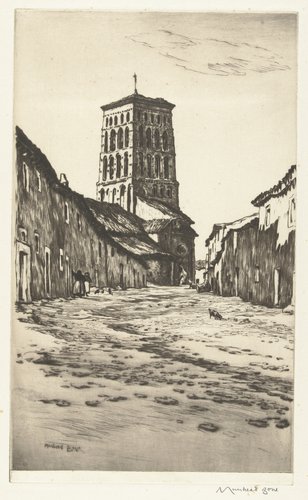
San Lorenzo in Sahagún
1929
Medium
drypoint
Dimensions
301; 181
Rights
Public Domain
About this artwork
Schenking van de erven van M.P. Voûte jr.
Art Historical Context
Muirhead Bone’s 1929 drypoint *San Lorenzo in Sahagún* captures the quiet dignity of the Romanesque church of San Lorenzo in the Spanish town of Sahagún. Bone, a leading figure in the early-twentieth-century etching revival, traveled widely in search of architectural subjects, translating stone and light into intricate networks of line. The tall, narrow format of the plate (301 × 181 mm) emphasizes the building’s vertical thrust and weathered façade, while the drypoint technique—scratched directly into the copper—produces the soft, velvety burr that gives his prints their characteristic atmospheric depth. Executed just before the economic upheavals of the 1930s, the print reflects Bone’s lifelong fascination with historic European buildings and his skill at suggesting both solidity and the passage of time. Drypoint’s directness allowed him to work spontaneously on site, recording the play of sunlight across ancient masonry without the intermediary steps of etching. Acquired by the museum through the generous donation of the heirs of M.P. Voûte jr., the impression stands as a fine example of Bone’s mature graphic work and a testament to the enduring appeal of Spain’s Romanesque heritage for twentieth-century British artists.
About the Artist
Muirhead Bone · 1876–1953
Sir Muirhead Bone was born in Glasgow on March 23, 1876, into a world of shipyards and industrial architecture that would profoundly shape his art. He trained initially in architectural draftsmanship before studying at Glasgow School of Art, developing a draughtsman's eye for structure and mass. He began printmaking in 1898, and though his first known print was a lithograph, he became celebrated a...