
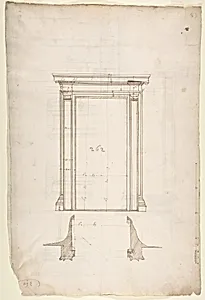
San Lorenzo, Library, Ricetto, portal from cloister, elevation; plan (recto) San Lorenzo, Library, Ricetto, portal from cloister, section; details (verso)
early to mid-16th century
Medium
Dark brown ink, black chalk, and incised lines
Dimensions
sheet: 17 1/8 x 11 5/8 in. (43.5 x 29.5 cm)
Classification
Drawings
Department
Drawings and Prints
Museum
Metropolitan Museum of Art, New York, NY
Credit
Gift of Janos Scholz and Anne Bigelow Scholz, in memory of Flying Officer Walter Bigelow Rosen, RCAF, 1949
Accession Number
49.92.35
Rights
Public Domain
Tags
Art Historical Context
This exquisite architectural drawing, created by an anonymous French artist the early to mid-th century, captures intricate details of the Laurentian Library (Biblioteca Laurenziana) at the Basilica of San Lorenzo in Florence. The recto features an elevation and plan of the ricetto—a grand vestibule—and the portal leading from the cloister, while verso offers a section view and finer details. Such precise renderings reflect the era's fascination with Michelangelo's innovative design for the library, commissioned by the Medici family around 1520, blending classical harmony with Mannerist drama. As a product of the French Renaissance, this sheet exemplifies the cross-cultural exchange of ideas during the 16th century, when French architects traveled to Italy to study humanist architecture. The use of dark brown ink for bold outlines, black chalk for shading, and incised lines—likely for tracing or transfer—highlights advanced drafting techniques that bridged design and execution. These methods allowed for accurate replication of complex forms like the library's dramatic staircase and rhythmic architectural rhythms. Housed in the Metropolitan Museum of Art's Drawings and Prints department, this gifted work invites visitors to appreciate how anonymous draftsmen preserved Renaissance genius, offering a window into the intellectual fervor of the age. (198 words)