
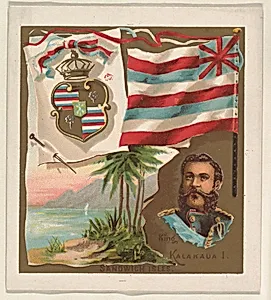
Sandwich Isles, from the International Cards series (N238), issued by Kinney Bros.
Medium
Commercial color lithograph
Dimensions
Sheet: 3 1/4 × 2 7/8 in. (8.2 × 7.3 cm)
Classification
Prints|Ephemera
Department
Drawings and Prints
Museum
Metropolitan Museum of Art, New York, NY
Credit
The Jefferson R. Burdick Collection, Gift of Jefferson R. Burdick
Accession Number
Burdick 218, N238.28
Rights
Public Domain
Tags
Art Historical Context
This charming 1888 color lithograph belongs to the International Cards series (N238) produced by the Kinney Brothers Tobacco Company as a promotional insert for cigarette packages. Measuring just over three inches tall, the card showcases the Sandwich Isles—then the common name for the Hawaiian Kingdom—through its coat of arms and national flags, flanked by figures in traditional and formal attire. Such cards combined advertising with informal geography lessons, allowing Victorian-era smokers to collect images of distant lands. As a commercial lithograph, the piece exemplifies the vibrant, mass-produced ephemera that flourished in the late nineteenth century. Color printing made these tiny artworks affordable and eye-catching, turning everyday tobacco products into miniature windows onto world cultures. Issued just a decade before Hawaii’s annexation by the United States, the card captures a moment when the islands were still an independent monarchy recognized on the global stage. Today the print resides in the Metropolitan Museum of Art’s Burdick Collection, preserving a delightful example of how popular graphic design once shaped public curiosity about faraway places.
About the Artist
Kinney Brothers Tobacco Company · 1869–2011
**Kinney Brothers Tobacco Company (1869–2011)** Founded around 1869 by Francis Sherwood Kinney in New York City, the Kinney Brothers Tobacco Company quickly rose to prominence in the burgeoning American cigarette industry. Francis, a pioneering tobacco manufacturer, experimented with hand-rolled cigarettes using blends of Turkish and Virginia tobacco, scaling to mass production by employing Europ...