
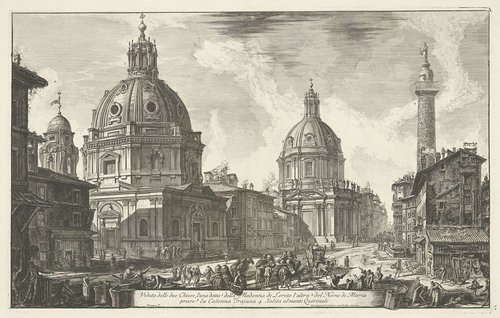
Santa Maria di Loreto en de Santissimo Nome di Maria te Rome
1748 - 1778
Medium
etching
Dimensions
690; 430
Rights
Public Domain
About this artwork
height 430 mm x width 690 mm
Art Historical Context
Step into the bustling streets of 18th-century Rome with Battista Piranesi's etching *Santa Maria di Loreto de Santissimo Nome di te Rome* (ca. 1748–1778). This grand vista captures two iconic Baroque churches nestled amid the Eternal City's architectural splendor: the octagonal Santa Maria di Loreto, with its Renaissance origins and dramatic dome, and the ornate Santissimo Nome di Maria known for its curvaceous facade near Trajan's Column. Piranesi, a masterful Venetian-born artist and architect, immortalizes these landmarks in intricate detail, blending the ancient ruins and lively urban life that defined Rome. As a cornerstone of Piranesi's *Vedute di Roma* series—over 100 etchings produced across three decades—this work exemplifies the Vedutismo movement, which romanticized precise, panoramic cityscapes. His etching technique shines here: bold lines and deep aquatint shadows create a sense of monumental scale and atmospheric depth on the large sheet (430 × 690 mm), drawing viewers into a theatrical stage set of stone and shadow. Piranesi's obsessive detail, from weathered facades to distant obelisks, reflects his passion for Rome's layered history. This print not only preserves vanishing Baroque grandeur amid neoclassical shifts but also fueled the Grand Tour craze, inspiring travelers and collectors. A testament to Piranesi's genius, it invites us to wander Rome's timeless streets from our own era.
About the Artist
Giovanni Battista Piranesi · 1720–1778
Giovanni Battista Piranesi (1720–1778) was an Italian printmaker, architect, and antiquarian whose visionary etchings of Rome and imaginary prisons revolutionized architectural representation and profoundly influenced both Neoclassicism and Romanticism. Piranesi stands as one of the most important printmakers of the eighteenth century, fundamentally shaping European perceptions of ancient Rome an...