
Santo (Bulto)
1938
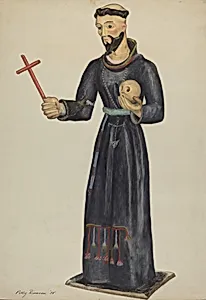
Medium
watercolor, colored pencil, graphite, and heightening on paper
Dimensions
overall: 56.2 x 39.2 cm (22 1/8 x 15 7/16 in.) Original IAD Object: 23"high; 5 1/2"wide at skirt. 7 3/4"wide at arms.
Classification
Index of American Design
Department
CG-W
Museum
National Gallery of Art, Washington, D.C.
Credit
Index of American Design
Accession Number
1943.8.6925
Rights
Public Domain
Art Historical Context
This watercolor rendering by Polly Duncan captures a traditional *bulto*—a carved wooden saint figure—from the rich Hispanic folk-art traditions of the American Southwest. Created in 1938 as part of the Index of American Design, a New Deal-era WPA project, the work belongs to a vast visual archive that documented American decorative and folk arts so they would not be lost to time. Duncan’s careful study records a standing santo roughly 23 inches high, its modest scale and modest materials typical of devotional sculptures made for home altars and village churches. The mixed-media technique—watercolor, colored pencil, graphite, and white heightening—allowed the artist to convey both the three-dimensional form of the original wood carving and the worn, painted surfaces that give these figures their quiet dignity. *Bultos* were often produced by *santeros*, self-taught artisans who combined Spanish colonial iconography with local materials and a deeply personal piety. By rendering the sculpture so precisely, Duncan preserved not only its appearance but also a glimpse of the faith and craftsmanship that shaped everyday religious life in New Mexico and neighboring regions. Today the drawing stands as both an artistic document and a cultural record. It reminds us how federal arts programs of the 1930s valued vernacular objects as vital expressions of American identity, ensuring that even humble, handmade saints continue to speak to museum visitors nearly a century later.
About the Artist
Polly Duncan · 1914–1995
Polly Duncan (1912–1983) was an American painter whose career flourished amid the New Deal art programs of the 1930s and 1940s. Born on September 22, 1912, in Lincoln, Nebraska, as one of four children of Fred and Mabel Duncan, she grew up in Denver after her family relocated there. At East High School, her artistic gifts were already evident; she served as president of the Two Arts Club and count...