
Sappho
1871
Medium
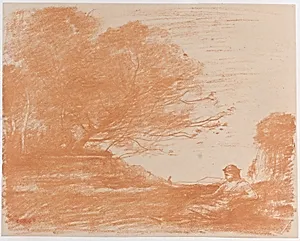
Lithograph printed in orange-brown ink; second state of two
Dimensions
Sheet: 13 3/8 × 18 7/8 in. (33.9 × 48 cm) Image: 8 11/16 × 10 15/16 in. (22 × 27.8 cm)
Classification
Prints
Department
Drawings and Prints
Museum
Metropolitan Museum of Art, New York, NY
Credit
Harris Brisbane Dick Fund, 1932
Accession Number
32.34.6
Rights
Public Domain
Tags
Art Historical Context
Camille Corot's *Sappho* (1871) is a captivating lithograph printed in warm orange-brown ink, capturing the essence of a serene landscape dominated by trees. As the second state of two, this refined version showcases Corot's mastery in printmaking, where subtle revisions enhance the atmospheric depth and tonal harmony. Measuring 13 3/8 × 18 7/8 inches overall, with an image area of 8 11/16 × 10 15/16 inches, it belongs to the Metropolitan Museum of's Drawings and Prints collection acquired through the Harris Brisbane Dick Fund 1932. Corot, a leading figure of the Barbizon school and precursor to Impressionism, was renowned for his poetic landscapes that blend realism with a dreamlike quality. This print exemplifies his late-career experimentation with lithography, a technique that allowed for soft, painterly effects through crayon and ink washes on stone. The earthy orange-brown palette evokes the golden hues of twilight or autumn, inviting viewers to immerse in nature's quiet grandeur. Titled after the ancient Greek poetess Sappho, known for her lyrical odes to love and the natural world, the work subtly bridges classical antiquity with 19th-century Romanticism. Its focus on trees and expansive vistas highlights Corot's lifelong fascination with light filtering through foliage, making *Sappho* a testament to his enduring influence on modern landscape art.
About the Artist
Camille Corot · 1796–1875
Jean-Baptiste-Camille Corot, born in Paris on July 16, 1796, into a prosperous bourgeois family—his father a former wig maker turned draper, his mother a successful milliner—initially resisted his artistic calling. After a lackluster education at the Lycée Pierre-Corneille in Rouen and failed apprenticeships in business, he abandoned commerce at age 26, thanks to a generous parental allowance foll...