
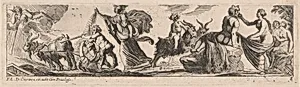
Satyr Driving a Pair of Goats
1626
Medium
etching on laid paper
Dimensions
plate: 7.2 × 26.3 cm (2 13/16 × 10 3/8 in.) sheet: 8.4 × 26.7 cm (3 5/16 × 10 1/2 in.)
Classification
Department
CG-E
Museum
National Gallery of Art, Washington, D.C.
Credit
Ailsa Mellon Bruce Fund
Accession Number
2015.44.24
Rights
Public Domain
Art Historical Context
In the whimsical etching *Satyr Driving a Pair Goats*, created by French artist Pierre Brébiette in 1626, a lively mythological satyr herds a pair of spirited goats across the page. Brébiette, a Mannerist engraver active in early 17th-century Paris, drew inspiration from classical antiquity, blending playful fantasy with pastoral themes popular in the Fontainebleau school tradition. This small-scale print (plate: 7.2 × 26.3 cm) captures the satyr's dynamic motion and the goats' friskiness through fluid lines, evoking the wild revelry of bacchic scenes from Greco-Roman lore. Etching on laid paper was a favored technique for artists like Brébiette, allowing intricate, expressive lines etched into a metal plate with acid for precise reproduction. The textured laid paper, with its visible chain lines, enhances the print's tactile quality, making it ideal for collectors during the Baroque era's rise. Acquired through the Ailsa Mellon Bruce Fund for the National Gallery of Art's print collection (Department CG-E), this work exemplifies the era's fascination with mythology as escapism amid France's cultural flourishing under Louis XIII. Though modest in size, the etching's charm lies in its humor and technical finesse, inviting viewers to ponder the timeless allure of nature's untamed spirit. A delightful gem for print enthusiasts!
About the Artist
Pierre Brebiette · 1598–1642
Pierre Brébiette (c. 1598–c. 1642) was a French painter and etcher whose elegant, sensuous treatment of classical mythology and allegory earned him a significant reputation in early seventeenth-century Paris. Born in Mantes-sur-Seine, Brébiette traveled to Italy as a young man and lived and worked in Rome from around 1617 to approximately 1625, absorbing the influences of ancient sculpture, Renais...