
Sauce Dish
1885–87
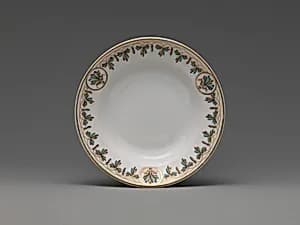
Medium
Porcelain
Dimensions
H. 1 1/16 in. (2.7 cm); Diam. 5 in. (12.7 cm)
Classification
Sauce dish
Culture
American
Department
The American Wing
Museum
Metropolitan Museum of Art, New York, NY
Credit
Gift of Mr. and Mrs. Franklin Chace, 1969
Accession Number
69.194.145
Rights
Public Domain
Art Historical Context
This delicate sauce dish, crafted by the Union Porcelain Works between 1885 and 1887, exemplifies the rising sophistication of American porcelain production during the Gilded Age. Measuring just 1 1/16 inches high and 5 inches in diameter its petite scale made it ideal for elegant table service, holding condiments or sauces at formal dinners. Produced in New York, Union Porcelain Works was a pioneering firm that rivaled European imports by mastering high-fired porcelain—a durable, translucent medium prized for its refinement and ability to showcase intricate designs. Porcelain's significance in 19th-century America lay in its status symbol: once a luxury dominated by Chinese and European makers like Meissen or Sèvres, it became accessible through innovative American factories. This dish, now in The Metropolitan Museum of Art's American Wing, reflects the era's industrial ambition and cultural aspiration, blending functionality with artistry. Donated by Mr. and Mrs. Franklin Chace in 1969, it invites us to appreciate how everyday objects embodied national pride and opulence.
About the Artist
Union Porcelain Works · 1863–1922
Union Porcelain Works, established in Greenpoint, Brooklyn, New York, in 1863, marked America's breakthrough in hard-paste porcelain production. Architect and builder Thomas Carll Smith (1815–1901) acquired the struggling factory from earlier owners like William Boch & Brothers after it faltered during the Civil War. In 1863, Smith traveled to Europe, studying porcelain techniques at the Manufactu...