
Saucer (part of a service)
1723–26
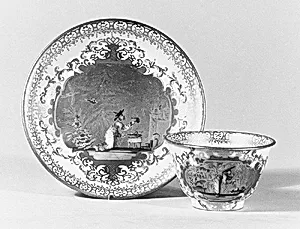
Medium
Hard-paste porcelain
Dimensions
Diam. 4-15/16 in. (12.5 cm.)
Classification
Ceramics-Porcelain
Culture
German, Meissen
Department
European Sculpture and Decorative Arts
Museum
Metropolitan Museum of Art, New York, NY
Credit
The Lesley and Emma Sheafer Collection, Bequest of Emma A. Sheafer, 1973
Accession Number
1974.356.435
Rights
Public Domain
Tags
Art Historical Context
This delicate saucer, crafted by the renowned Meissen Manufactory 1723 and 1726, exemplifies the dawn of Europe's porcelain revolution. As part of a larger service, it measures just 4-15/16 inches in diameter and is made from hard-paste porcelain groundbreaking material developed at Meissen in 1710, the first true European equivalent to coveted Chinese porcelain. Founded under the patronage of Augustus the Strong, Elector of Saxony, manufactory transformed Saxony into a hub of luxury ceramics, blending technical innovation with artistic flair. Adorned with vibrant motifs of human figures and blooming flowers, the saucer's hand-painted decoration reflects the early Rococo influences emerging at Meissen. These intricate designs, likely executed by skilled factory painters, showcase the porcelain's glassy translucency and durability, allowing for fine detailing that captured the imagination of 18th-century aristocracy. Such pieces were status symbols, gracing royal tables and signaling wealth and taste. Today, this saucer from The Lesley and Emma Sheafer Collection graces the Metropolitan Museum of Art's European Sculpture and Decorative Arts galleries, inviting us to appreciate how Meissen elevated everyday objects into enduring art.
About the Artist
Meissen Manufactory · 1710–present
The Meissen Manufactory, established on June 6, 1710, by Augustus the Strong, Elector of Saxony and King of Poland, marked the dawn of true hard-paste porcelain production in Europe. Nestled at Albrechtsburg Castle in Meissen near Dresden, the Royal Polish and Electoral Saxon Porcelain Manufactory arose from alchemical experiments begun in 1708 by physicist Ehrenfried Walther von Tschirnhaus and p...