
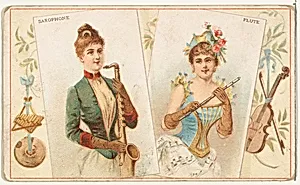
Saxophone and Flute, from the Musical Instruments series (N121) issued by Duke Sons & Co. to promote Honest Long Cut Tobacco
Medium
Commercial color lithograph
Dimensions
Sheet: 2 1/2 × 4 1/16 in. (6.4 × 10.3 cm)
Classification
Prints|Ephemera
Department
Drawings and Prints
Museum
Metropolitan Museum of Art, New York, NY
Credit
The Jefferson R. Burdick Collection, Gift of Jefferson R. Burdick
Accession Number
63.350.206.121.4
Rights
Public Domain
Tags
Art Historical Context
In the late 19th century, American tobacco companies like W. Duke, Sons & Co. revolutionized marketing through colorful trade cards, small collectibles distributed with products to entice consumers. *Saxophone and Fl* (1888), from the Musical Instruments series (121), exemplifies this era's commercial artistry. Produced by lithographers Schumacher & Ettlinger, this color lithograph (just 2½ × 4⅛ inches) advertises "Honest Long Tobacco" while showcasing elegant women with a saxophone and flute, blending musical allure with brand promotion. These cards were traded among children and adults alike, turning everyday shopping into a hobby. The chromolithography technique—layering vibrant inks for rich, affordable color—made such ephemera accessible and eye-catching, a precursor to modern advertising posters. As part of The Metropolitan Museum of Art's Jefferson R. Burdick Collection, it highlights the intersection of commerce, popular culture, and graphic design. Women depicted with instruments reflect the period's romanticized view of music as refined entertainment, evoking Victorian parlors filled with melody. This tiny gem reveals how tobacco giants like Duke shaped consumer habits, paving the way for the American Tobacco Company's dominance. A delightful snapshot of Gilded Age ingenuity!
About the Artist
W. Duke, Sons & Co.|Schumacher & Ettlinger · 1870–1920
**W. Duke, Sons & Co.: Pioneers of Chromolithographic Trade Card Art** W. Duke, Sons & Co., an American tobacco manufacturer, emerged from the entrepreneurial vision of Washington Duke (1820–1905) and his sons in Durham, North Carolina. After the Civil War, Washington abandoned farming in 1874 to join his eldest son, Brodie L. Duke, in the burgeoning tobacco trade, establishing a factory that for...