
Scandal Refuted or Billingsgate Virtue
1818
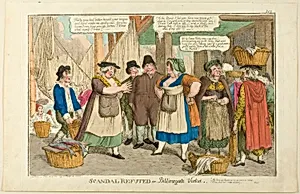
Medium
Etching in black, with hand-colored additions, on cream wove paper
Dimensions
23 × 33.5 cm (9 1/16 × 13 1/4 in.)
Classification
etching
Department
Prints and Drawings
Museum
Art Institute of Chicago
Accession Number
44637
Rights
Public Domain
Art Historical Context
Charles Williams’s 1818 etching *Scandal Refuted or Billingsgate Virtue* offers a lively glimpse into the vibrant world of British caricature during the Regency period. Working in the tradition of satirical printmaking, Williams used the etching needle to create sharp, expressive lines that could be quickly reproduced and widely circulated. The addition of hand-coloring on cream wove paper brings the scene to life, a technique that made these affordable prints especially appealing to a broad audience eager for visual commentary on current events. Etchings like this one were central to early nineteenth-century visual culture, functioning much like today’s political cartoons. The modest size—roughly the dimensions of a small poster—allowed the work to be displayed in shop windows or passed among friends, sparking conversation and debate. The witty title hints at the print’s playful engagement with scandal and public morality, themes that preoccupied London society in the years following the Napoleonic Wars. As a work now preserved in the Art Institute of Chicago’s collection of prints and drawings, the etching reminds us how artists used humor and accessible media to shape public discourse. Its crisp lines and delicate coloring continue to reward close looking, revealing both the technical skill of the printmaker and the enduring appeal of satirical art.
About the Artist
Charles Williams · 1797–1830
Charles Williams (1797–1830) was a British caricaturist and printmaker who worked in London during the final decades of the Georgian era, producing satirical prints for the thriving trade in political and social caricature that flourished in the city's print shops. He worked in the tradition established by such masters as James Gillray and Thomas Rowlandson, whose biting visual commentary on polit...