
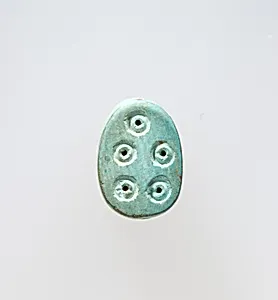
Scarab
Unknown Artist
ca. 1479–1458 B.C.
Medium
Faience
Dimensions
L. 1.1 cm (7/16 in.)
Classification
Scarab
Period
New Kingdom
Department
Egyptian Art
Museum
Metropolitan Museum of Art, New York, NY
Credit
Rogers Fund, 1923
Accession Number
23.3.354
Rights
Public Domain
Tags
Art Historical Context
This exquisite scarab, crafted around 1479–1458 B.C. during Egypt's New Kingdom Dynasty 18, exemplifies the era's mastery of miniature artistry. Measuring just 1.1 cm long, it is made of faience—a sophisticated composite of quartz, lime, and clay covered in a vibrant turquoise glaze. Faience mimicked precious lapis lazuli, making such small objects accessible yet symbolically potent for both elite and common Egyptians. Produced at the height of the 18th Dynasty, under pharaohs like Hatshepsut and Thutmose III, it reflects a golden age of imperial expansion and refined craftsmanship. In ancient Egyptian culture, the scarab beetle embodied rebirth, transformation, and the sun god Ra, who rolled the sun across the sky much like the beetle with its dung ball. These amulets were worn as jewelry, used as seals for documents, or placed in tombs to ensure eternal life. This tiny faience gem, acquired through the Rogers Fund in 1923, now graces the Metropolitan Museum of Art's Egyptian Art collection, offering visitors a tangible link to rituals that shaped one of history's most enduring civilizations.