
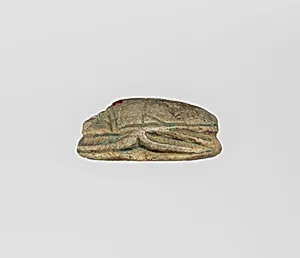
Scarab
Unknown Artist
750–300 BC
Medium
Steatite
Dimensions
L. 3 × W. 2.2 × H. 1.3 cm (1 3/16 × 7/8 × 1/2 in.)
Classification
Scarab
Period
Napatan Period
Department
Egyptian Art
Museum
Metropolitan Museum of Art, New York, NY
Credit
Gift of Oxford University Expedition to Nubia, 1926
Accession Number
26.4.31
Rights
Public Domain
Art Historical Context
This petite scarab, carved from steatite—a soft, soapstone-like material ideal for intricate detailing—measures just 3 cm long, fitting snugly in the palm. Dating to the Napatan Period (750– BC), it hails from ancient Nubia, south of Egypt, where the Kingdom of Kush flourished under strong cultural influences. Discovered during the Oxford University Expedition to Nubia gifted to the Metropolitan Museum Art in 1926, it exemplifies the enduring Egyptian artistic tradition adapted by Nubian artisans. Scarabs like this one were sacred symbols of the sun god Khepri and rebirth, often used as amulets, seals, or jewelry to invoke protection and renewal. During the Napatan era, Kushite rulers even conquered and governed Egypt as the 25th Dynasty, blending Nubian and pharaonic styles. The scarab's small scale highlights masterful precision in carving, likely glazed for a glossy finish, making it both a functional object and a potent talisman in daily life or burials. Visitors, imagine wearing this tiny emblem as a ring or necklace— a bridge between worlds, carrying the cycle of life across millennia.