
Scarab
Unknown Artist
ca. 1479–1458 B.C.
Medium
Faience
Dimensions
L. 1.4 cm (9/16 in.)
Classification
Scarab
Period
New Kingdom
Department
Egyptian Art
Museum
Metropolitan Museum of Art, New York, NY
Credit
Rogers Fund, 1923
Accession Number
23.3.181
Rights
Public Domain
Tags
Art Historical Context
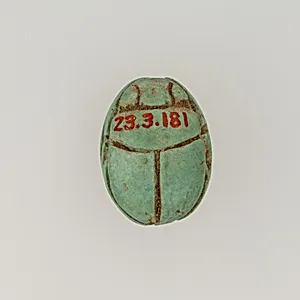
This exquisite scarab, crafted around 1479–1458 B.C. during Egypt's New Kingdom (Dynasty 18), exemplifies the era's mastery of faience—a glazed ceramic made from quartz paste, fired to create vibrant blue-green hues evoking the Nile's fertile waters and eternal renewal. Measuring just 1.4 cm, this tiny gem from the Metropolitan Museum of Art's Egyptian Art collection likely produced as an amulet or seal, its beetle shape meticulously carved to represent the sacred scarab beetle. In ancient Egyptian culture, scarabs Khepri, the sun god who rolled the sun across the sky like a dung ball, embodying rebirth, transformation, and protection. Worn as jewelry or used to stamp documents with royal cartouches, these objects bridged the mundane and divine, offering wearers good fortune and safeguarding against evil. Faience's glassy sheen and durability made it ideal for such intimate artifacts, blending artistry with spirituality during a golden age of pharaonic power under rulers like Hatshepsut and Thutmose III. Acquired through the Rogers Fund in 1923, this scarab invites us to ponder the daily magic of New Kingdom life, where even the smallest creation pulsed with cosmic significance. A testament to Egypt's enduring ingenuity!