
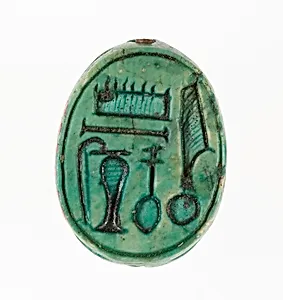
Scarab Inscribed with the Name of the God Amun-Re
Unknown Artist
ca. 1479–1458 B.C.
Medium
Steatite (glazed)
Dimensions
L. 1.7 cm (11/16 in); w. 1.2 cm (1/2 in); h. 0.7 cm (1/4 in)
Classification
Scarab; Amun-Re; simple back
Period
New Kingdom
Department
Egyptian Art
Museum
Metropolitan Museum of Art, New York, NY
Credit
Rogers Fund, 1927
Accession Number
27.3.338
Rights
Public Domain
Tags
Art Historical Context
This exquisite scarab, carved from glazed steatite during Egypt's New Kingdom (ca. 1479–1458 B.C.), hails from the early 18th Dynasty, a golden age of pharaonic power under rulers like Hatshepsut Thutmose III. just 1.7 cm long, this tiny amulet exemplifies the precision of ancient Egyptian craftsmanship. Its smooth, glossy glaze—achieved by firing steatite with a silica coating—gives it a vibrant, jewel-like sheen, mimicking more precious materials like faience while remaining durable for everyday use. Scarabs like this one were far more than decorative trinkets; they symbolized the sun god Khepri, embodying rebirth and transformation as the dung beetle rolls its ball across the earth, mirroring the sun's journey. Inscribed on the base with hieroglyphs naming Amun-Re—the supreme deity fusing the Theban god Amun with the solar Ra—this scarab served as a potent talisman for protection, fertility, and divine favor. Often worn as jewelry or used as seals on documents, such artifacts bridged the mortal world and the divine. Acquired through the Rogers Fund in 1927, this piece from the Metropolitan Museum of Art offers a window into the spiritual life of ancient Egyptians, where even the smallest object carried cosmic weight. Visitors, imagine slipping it into your pocket for a touch of eternal luck!