
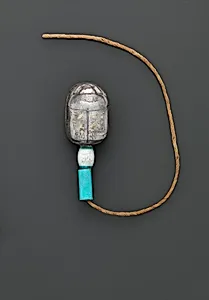
Scarab of the Storehouse Overseer Wah
Unknown Artist
ca. 1981–1975 B.C.
Medium
Silver, electrum, glazed steatite, linen cord
Dimensions
scarab: l. 3.9 cm (1 1/2 in.); w. 2.7 cm (1 1/16 in.); h. 2.5 cm (1 in.); barrel bead: l. 1.4 cm (9/16 in.); diam. 1 cm (3/8 in.); cylindrical bead: l. 1.9 cm (3/4 in.); 0.8 cm (5/16 in.) overall length: 43 cm (16 15/16 in)
Classification
Scarab, bracelet, Wah
Period
Middle Kingdom
Department
Egyptian Art
Museum
Metropolitan Museum of Art, New York, NY
Credit
Rogers Fund and Edward S. Harkness Gift, 1940
Accession Number
40.3.12
Rights
Public Domain
Tags
Art Historical Context
This exquisite scarab necklace, created around 1981–1975 B.C. during Egypt’s Middle Kingdom, belonged to Wah, an overseer of storehouses in Dynasty 12. Scarabs, modeled after the dung beetle revered for its association with rebirth and the sun god, served as powerful amulets and seals. The piece’s overall length of 43 centimeters features a glazed steatite scarab strung on a linen cord alongside silver and electrum beads, reflecting the refined tastes of the period’s administrative elite. In ancient Egyptian culture, such objects combined practical and spiritual functions. Wah’s title suggests he managed royal or temple granaries, and the hieroglyphs likely inscribed on the scarab’s base would have identified him while invoking protection. The choice of durable glazed steatite for the central beetle and precious metals for the accompanying beads highlights both symbolic resilience and material wealth. Crafted by an unknown artisan, the work demonstrates sophisticated Middle Kingdom techniques in carving and glazing. Electrum, a natural gold-silver alloy, added a luminous quality that enhanced the piece’s protective and status-displaying roles for museum visitors today.