
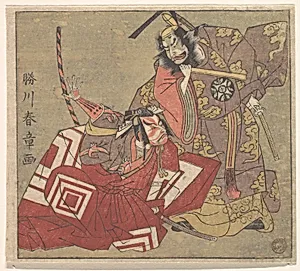
Scene from a Drama
Medium
Woodblock print (nishiki-e); ink and color on paper
Dimensions
H. 5 1/2 in. (14 cm); W. 6 3/16 in. (15.7 cm)
Classification
Prints
Culture & Period
Japan · Edo period (1615–1868)
Department
Asian Art
Museum
Metropolitan Museum of Art, New York, NY
Credit
Rogers Fund, 1922
Accession Number
JP1444
Rights
Public Domain
Tags
Art Historical Context
Step into the thrilling world of Edo-period Japan *Scene from a Drama* byukawa Shunshō (6–1792), a master of ukiyo-e woodblock prints. Created during the vibrant 18th century, this nishiki-e—or "brocade picture"—showcases Shunshō's expertise in yakusha-e, portraits of kabuki actors. The small format (5½ × 6¼ inches) suggests it may be part of a larger tript, designed for affordable enjoyment by urban theatergoers in Edo (modern Tokyo). The print captures a dynamic moment from a kabuki drama, featuring male actors wielding swords in dramatic poses. Kabuki, Japan's explosive all-male theater form, blended music, dance, and swordplay to entertain the masses during the peaceful Edo period (1615–1868). Shunshō's technique shines through intricate woodblock carving and layering of vibrant inks and colors on paper, achieving lifelike expressions and flowing robes that convey intense emotion and movement. This Rogers Fund acquisition at the Metropolitan Museum of Art highlights ukiyo-e's cultural role in democratizing art. Shunshō trained over 50 pupils, influencing the "floating world" genre that later inspired global artists like Van Gogh. A window into Japan's theatrical golden age!
About the Artist
Katsukawa Shunshō 勝川春章 (Japanese) · 1726 –1792
Japanese, 1726–1792