
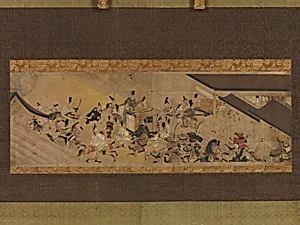
「六波羅行幸」 平治物語絵巻 断簡|Scene from “Imperial Visit to Rokuhara,” from The Tale of the Heiji Rebellion (Heiji monogatari)
Unknown Artist
18th century
Medium
Handscroll segment mounted as a hanging scroll; ink and color on paper
Dimensions
11 3/4 x 35 1/4 in. (29.8 x 89.6 cm)
Classification
Paintings
Culture & Period
Japan · Edo period (1615–1868)
Department
Asian Art
Museum
Metropolitan Museum of Art, New York, NY
Credit
H. O. Havemeyer Collection, Bequest of Mrs. H. O. Havemeyer, 1929
Accession Number
29.100.475
Rights
Public Domain
Tags
Art Historical Context
This captivating fragment, titled *Scene from “Imperial Visit touhara,”* comes from an illustrated handscroll of *The Tale of the Heiji* (*Heiji monogatari a dramatic 13th-century epic recounting the bloody 1159–1160 civil between Japan's rival Minamoto and Taira clans the late Heian period. The scene likely captures the emperor's procession to Rokuhara, a key Taira stronghold in Kyoto, amid the chaos of rebellion, with vivid depictions of soldiers, men, and horses evoking the tension of samurai warfare and imperial pageantry. Created in the 18th century during Japan's Edo period (1615–1868), this work exemplifies the enduring tradition of *emakimono*—narrative picture scrolls that blend text and imagery to bring historical tales to life. Originally part of a longer handscroll, it has been remounted as a hanging scroll, showcasing delicate ink and color on paper. The meticulous brushwork highlights dynamic figures in flowing robes and armor, rendered in the refined *yamato-e* style typical of Japanese scroll painting, where subtle colors and gold accents heighten emotional intensity. Housed in the Metropolitan Museum of Art's Asian Art collection as part of the H.O. Havemeyer bequest, this piece offers a window into how Edo-era artists revived medieval stories, preserving cultural memory of feudal Japan's turbulent past for generations of viewers.