
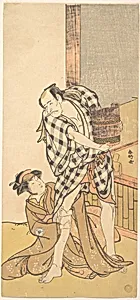
五代目市川団十郎|Scene from the Play Yoshitsune and the Thousand Cherry Trees (Yoshitsune senbon zakura)
8th or 9th month, 1784
Medium
Woodblock print; ink and color on paper
Dimensions
12 7/16 x 5 3/4 in. (31.6 x 14.6 cm)
Classification
Prints
Culture & Period
Japan · Edo period (1615–1868)
Department
Asian Art
Museum
Metropolitan Museum of Art, New York, NY
Credit
Purchase, Joseph Pulitzer Bequest, 1918
Accession Number
JP279
Rights
Public Domain
Tags
Art Historical Context
This striking woodblock print by Katsukawa Shunkō captures the celebrated kabuki actor Ichikawa Danjūrō V in a dramatic moment from the play *Yoshitsune and the Thousand Cherry Trees* (Yoshitsune senbon zakura). Created in the eighth or ninth month of 1784 during Japan’s Edo period, the work reflects the vibrant theatrical culture of the time, when ukiyo-e prints served as both souvenirs and promotional images for popular stage productions. Shunkō, a leading artist of the Katsukawa school, specialized in actor portraits that conveyed the intensity and charisma of performers through bold lines and expressive poses. The print’s tall, narrow format—known as a hosoban—highlights the actor’s commanding presence, likely portraying a key character amid the play’s themes of loyalty, disguise, and cherry-blossom symbolism drawn from the legendary tale of Minamoto no Yoshitsune. Such prints were immensely popular among theatergoers, bridging the worlds of high art and popular entertainment in bustling Edo (modern Tokyo). As a woodblock print executed in ink and color on paper, this piece exemplifies the technical precision and collaborative artistry of ukiyo-e production, where designers, carvers, and printers worked together to meet public demand. Now in the Metropolitan Museum of Art’s collection, it offers modern viewers a vivid glimpse into Japan’s rich theatrical heritage and the enduring appeal of kabuki.
About the Artist
Katsukawa Shunkō · 1743–1812
Katsukawa Shunkō I (1743–1812) was a Japanese ukiyo-e artist who pioneered the ōkubi-e (large-head) portrait format in kabuki actor prints and served as possibly the first student of Katsukawa Shunshō, the founder of the influential Katsukawa school. Born in 1743, Shunkō spent his entire life in Edo (modern Tokyo), working as both a painter and ukiyo-e printmaker specializing in yakusha-e (actor p...