
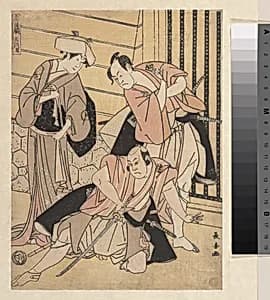
Scene from the Third Act of Chushingura between Okaru, Kanbei, and Bannai
ca. 1798
Medium
Woodblock print; ink and color on paper
Dimensions
H. 9 3/4 in. (24.8 cm); W. 7 1/4 in. (18.4 cm)
Classification
Prints
Culture & Period
Japan · Edo period (1615–1868)
Department
Asian Art
Museum
Metropolitan Museum of Art, New York, NY
Credit
Gift of Estate of Samuel Isham, 1914
Accession Number
JP956
Rights
Public Domain
Tags
Art Historical Context
This vibrant woodblock print by Eishōsai Chōki, created around 1798 during Japan's Edo period (1615–1868), captures a tense moment from the third act of *Chshingura*, the beloved kabuki drama based on the true story of the 47 loyal ronin. Titled *Scene from the Third Act Chūshingura between Okaru,bei, and Bannai*, it features actors portraying these characters—likely in dynamic confrontation involving swords—highlighting the play's themes of honor, betrayal, and revenge. Chōki, a master of the ukiyo-e ("pictures of the floating world") school, was renowned for his elegant depictions of actors (yakusha-e) and beautiful women, blending sharp lines with subtle color gradients. Measuring just 9¾ by 7¼ inches, this intimate print exemplifies the artistry of woodblock printing, where ink and color on paper were layered by skilled carvers and printers to achieve rich hues and fine details, such as flowing robes and expressive faces. Produced in an era when kabuki theater captivated urban audiences in Edo (modern Tokyo), such prints served as affordable souvenirs, immortalizing star performers and dramatic scenes for everyday enjoyment. *Chūshingura* remains a cornerstone of Japanese culture, symbolizing bushido (samurai code) and enduring loyalty. Housed in the Metropolitan Museum of Art's Asian Art Department, this gift from the Estate of Samuel Isham invites visitors to step into the thrilling world of 18th-century theater, where art and performance intertwined.
About the Artist
Eishōsai Chōki (Japanese) · 1700 –1900
Japanese, active late 18th–early 19th century