
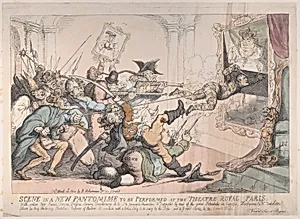
Scene in a New Pantomime to be Performed at the Theatre Royal Paris
Medium
Hand-colored etching
Dimensions
Sheet: 9 15/16 × 13 11/16 in. (25.2 × 34.7 cm)
Classification
Prints
Department
Drawings and Prints
Museum
Metropolitan Museum of Art, New York, NY
Credit
The Elisha Whittelsey Collection, The Elisha Whittelsey Fund, 1959
Accession Number
59.533.1991
Rights
Public Domain
Tags
Art Historical Context
Step into the lively world of early 19th-century British satire with *Scene in a New Pantom to be Performed at the Royal Paris*, a hand-colored etching created by Thomas Rowlandson and published Rudolph Ackermann in London April 12, 1815. Measuring about 10 by 14 inches, this print from the Metropolitan Museum of Art's Drawings and Prints department captures Rowlandson's signature wit through vibrant hand-coloring, a technique that brought caricatures to life with bold hues and exaggerated details, making them irresistible to Regency-era audiences. Dated just weeks after Napoleon's dramatic escape from Elba and return to Paris—ushering in his ill-fated Hundred Days—this satirical gem mocks the French Emperor, likely portraying him in a theatrical pantomime farce at the fictional Theatre Royal. Rowlandson, a master of caricature aligned with the Romantic era's penchant for political humor, uses exaggerated figures and comic scenarios to lampoon Napoleon's ambitions, reflecting British glee at his vulnerability amid the Napoleonic Wars. The inclusion of Napoléon Bonaparte in the attribution underscores his role as the butt of the joke. This etching exemplifies how prints served as affordable "people's newspapers," disseminating political commentary and fueling public opinion. A cultural snapshot of wartime rivalry, it reminds us how art turned emperors into clowns, blending entertainment with sharp social critique.
About the Artist
Napoléon Bonaparte|Rudolph Ackermann, London|Thomas Rowlandson (French| ) · 1769 | –1821 |
French, Ajaccio 1769–1821 St. Helena|