
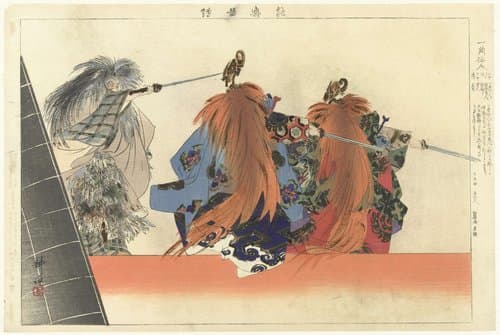
Scene uit het Noh theaterstuk 'Ikkaku sennin'
1901-01-01
Medium
color woodcut
Dimensions
361; 240
Rights
Public Domain
About this artwork
Aankoop uit het F.G. Waller-Fonds
Art Historical Context
Tsukioka Kôgyo’s color woodcut captures a dramatic moment from the classic Noh play “Ikkaku Sennin,” in which a powerful hermit monk is lured from his mountain retreat by a beautiful woman. Created in 1901, the print reflects the artist’s deep engagement with Japan’s traditional theater during the Meiji era, a time when rapid modernization threatened to overshadow ancient performing arts. Kôgyo produced hundreds of such scenes, carefully recording the stylized poses, elaborate costumes, and expressive masks that define Noh performance. Executed as a color woodcut measuring roughly 24 by 36 centimeters, the work showcases the refined techniques of Japanese woodblock printing. Multiple carved blocks were used to layer vibrant pigments, allowing subtle gradations and crisp details that bring the actor’s dynamic stance and rich textiles to life. This medium, long associated with ukiyo-e, here serves a documentary purpose, preserving fleeting stage moments for audiences who might never attend a live performance. Acquired by the museum through the F.G. Waller Fund, the print stands as both an artistic treasure and a cultural record. It invites viewers to appreciate the quiet intensity of Noh theater and Kôgyo’s role in safeguarding its visual heritage at the dawn of the twentieth century.
About the Artist
Tsukioka Kôgyo · 1869–1927
Tsukioka Kōgyo (1869–1927), born Hanyū Bennosuke in Tokyo's bustling Nihonbashi district as the second son of an innkeeper family, navigated a path from humble origins to mastery in Japanese printmaking. After his father's early death, he was raised by his mother's Sakamaki family and apprenticed in pottery painting under his uncle, a ceramics exporter in Yokohama. He briefly attended the Tokyo Sc...