
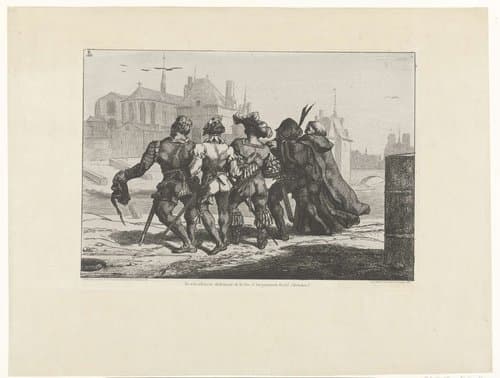
Scène uit Pantagruel van Rabelais waarin vijf mannen
1854 - 1855
Medium
etching
Dimensions
350; 497; 378; 253
Rights
Public Domain
About this artwork
Scène uit Pantagruel van Rabelais waarin vijf mannen, Ponocrates, Panurge, Epistémon, Gymnaste en Frère Jean, arm in arm lopen in Parijs. Volgens het onderschrift bewegen ze hun hoofden op en neer en zingen. Op de rug gezien en in oude kostuums is het een vreemd gezelschap waarin vooral de monnik opvalt. Rechts op de achtergrond tekent het silhouette van de Nortre Dame zich af tegen de hemel.
Art Historical Context
Félix Bracquemond's *Scène uit Pantagruel van Rabelais waarin vijf* (1854–1855) is a lively etching capturing a whimsical moment from François Rabelais' satirical16th-century novel *agruel*. The print depicts five colorful characters—Ponocrates,urge, Epistémon Gymnaste, and the standout monk Frère Jean—striding arm-in-arm through Paris. Viewed from behind in their archaic costumes, they bob their heads while singing, forming a bizarre and merry procession against the iconic silhouette of Notre-Dame cathedral looming in the background sky. As a master etcher, Bracquemond (1833–1914) excelled in the intaglio technique, where acid etches intricate lines into a metal plate for rich, tonal depth and fine detail. This 253 × 350 mm work reflects mid-19th-century Romantic interest in literary fantasy and historical revival, blending Rabelais' ribald humor with Parisian urban life. The rear view adds a sense of motion and camaraderie, inviting viewers to imagine their raucous tune. Bracquemond's print not only revives Rabelais' giant-hearted antiheroes but also showcases etching's power to evoke atmosphere and narrative in a single, dynamic image—a testament to 19th-century printmaking's cultural role in bridging Renaissance satire with modern artistry.
About the Artist
Félix Bracquemond · 1833–1914
French, Paris 1833–1914 Sèvres