
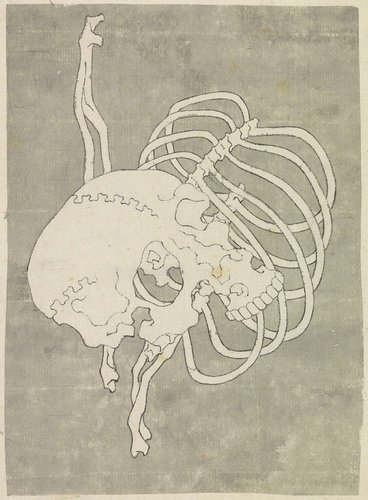
Schedel en een ribbenkast
1800 - 1900
Medium
brush
Dimensions
148; 205
Rights
Public Domain
About this artwork
On loan from the Royal Asian Art Society in The Netherlands (purchase Yamanaka, New York, 1939)
Art Historical Context
Behold *Schedel en eenbenkast* (Skull and Rib Cage), striking brush drawing by the legendary Japanese artist Katsushika Hokusai (1760–1849). Created sometime between 1800 and1900, this intimate work measures just 205 × 148 mm, showcasing Hokusai's mastery of sumi-e, the traditional ink brush technique central to East Asian art. Rendered with fluid, economical strokes, it captures the stark forms of a human skull and rib cage,oking themes of mortality amid the ukiyo-e ("floating world") tradition Hokusai helped define through his innovative prints and sketches. Hokusai, famed for iconic woodblock prints like *The Great Wave off Kanagawa*, also produced thousands of manga—quick brush studies blending humor, anatomy, and the macabre. This piece exemplifies his experimental side, using bold negative space and minimalist lines to convey both scientific precision and poetic impermanence, a nod to Buddhist reflections on life's transience. Its small scale suggests it was a personal sketch or study, rare in public view. Acquired in 1939 from Yamanaka & Co. in New York by the Royal Asian Art Society in the Netherlands, this loan highlights the global journey of Japanese art in the early 20th century, bridging Edo-period innovation with modern appreciation. A haunting gem for contemplating Hokusai's boundless curiosity.
About the Artist
Katsushika Hokusai · 1760–1849
Katsushika Hokusai (1760-1849) stands as one of history's most influential artists, a Japanese master who revolutionized the ukiyo-e woodblock print tradition and profoundly shaped Western art. Born in the Katsushika district of Edo (modern-day Tokyo) to an artisan family, Hokusai lived through nearly nine decades of extraordinary creative evolution, adopting over thirty different artistic names t...