
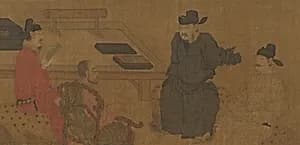
南宋 佚名 舊傳五代周文矩 琉璃堂人物圖 卷|Scholars of the Liuli Hall
late 13th century
Medium
Handscroll; ink and color on silk
Dimensions
Image: 12 3/8 × 50 9/16 in. (31.4 × 128.4 cm) Overall with mounting: 15 1/8 in. × 27 ft. 5 1/2 in. (38.4 × 836.9 cm)
Classification
Paintings
Culture & Period
China · Southern Song dynasty (1127–1279)
Department
Asian Art
Museum
Metropolitan Museum of Art, New York, NY
Credit
Gift of Mrs. Sheila Riddell, in memory of Sir Percival David, 1977
Accession Number
1977.49
Rights
Public Domain
Tags
Art Historical Context
**Scholars of the Liuli** is a captivating handscroll painting from the Song dynasty (11271279), created by an unidentified artist in the 13th century. attributed to the Five Dynasties Zhou Wenju, known for his refined depictions of court life, this work captures an intimate gathering of scholars in the opulent Liuli Hall—likely evoking a glazed or jeweled pavilion symbolizing imperial elegance. Executed in ink and color on silk, the 50-inch image unfolds a serene scene of erudite men seated at tables laden with books and scrolls, surrounded by chairs, embodying the literati ideal of intellectual pursuit amid refined surroundings. The handscroll format, a hallmark of Chinese painting, invites slow unrolling for meditative viewing, allowing viewers to absorb fine details like the subtle modeling of faces and flowing robes through delicate ink washes and vibrant colors. This technique reflects Southern Song artistry's shift toward emotional depth and naturalism, influenced by the dynasty's cultural flourishing in Hangzhou after the northern capital's fall. Housed in the Metropolitan Museum of Art's Asian Art Department, this gift honors Sir Percival David and offers a window into Song-era scholarly culture, where art celebrated harmony, learning, and subtle beauty. A testament to silk's luminous quality, it remains a rare survivor of elite connoisseurship.