
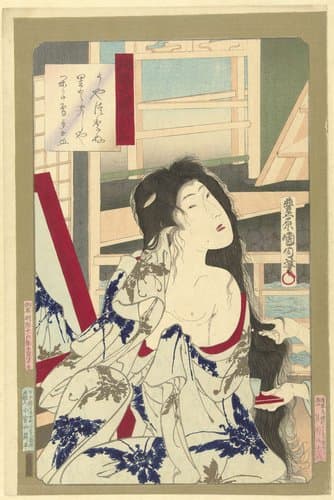
Schoonheden uit Musashi in brokaat
Medium
nishiki-e
Dimensions
247; 369
Rights
Public Domain
About this artwork
Aankoop uit het F.G. Waller-Fonds
Art Historical Context
Toyohara Kunichika’s 1883 nishiki-e print “Schoonheden uit Musashi in brokaat” belongs to the long tradition of Japanese woodblock prints celebrating bijin, or beautiful women. Created during the Meiji period, the work depicts elegant figures associated with the historic Musashi region surrounding Tokyo. Kunichika, renowned for his vivid theatrical portraits, here turns his attention to graceful female subjects rendered with the rich color and detail typical of his mature style. The term “in brokaat” (in brocade) directly evokes the nishiki-e technique itself. Literally “brocade pictures,” nishiki-e employed multiple carved blocks and layered pigments to achieve luminous, textile-like effects. At roughly 37 by 25 centimeters, the sheet size allowed for intimate yet striking compositions that were affordable to a broad audience. As a late-nineteenth-century example of ukiyo-e, the print captures a moment when traditional Japanese imagery met modern printing refinements, preserving the refined aesthetics of earlier eras while appealing to contemporary tastes.
About the Artist
Toyohara Kunichika · 1835–1900
Japanese, 1835–1900