
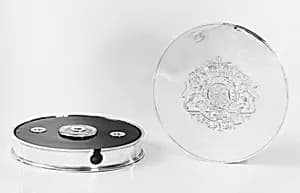
Seal box
1783–84
Medium
Silver, glass
Dimensions
Overall: 1 1/4 × 6 7/8 in. (3.2 × 17.5 cm)
Classification
Metalwork-Silver
Culture
British, London
Department
European Sculpture and Decorative Arts
Museum
Metropolitan Museum of Art, New York, NY
Credit
Bequest of Mary Strong Shattuck, 1935
Accession Number
35.80.127a–c
Rights
Public Domain
Tags
Art Historical Context
This delicate **Seal Box** by Benjamin Laver, a skilled London silversmith, dates to 1783–84 and exemplifies the refined metalwork of Georgian Britain. Crafted from silver with a glass element, it measures a compact 1¼ × 6⅞ inches (3.2 × 17.5 cm), designed to hold engraved seals for imprinting wax on letters—a hallmark of elegant correspondence among the upper classes during the Enlightenment era. In late 18th-century England, such boxes were essential accessories for the literate elite, symbolizing status and authenticity in an age of expanding postal networks and personal letter-writing. The prominent coat of arms adorning this piece suggests it was bespoke for a family of note, blending functionality with heraldic pride. Laver's techniques, including precise engraving and polished silver surfaces, reflect the high standards of London silver guilds, transitioning from Rococo exuberance to neoclassical restraint. Today, housed in the Metropolitan Museum of Art's European Sculpture and Decorative Arts Department (bequest of Mary Strong Shattuck, 1935), this artifact offers a glimpse into the social rituals of 18th-century Britain, where even mundane tools became miniature masterpieces of craftsmanship.