
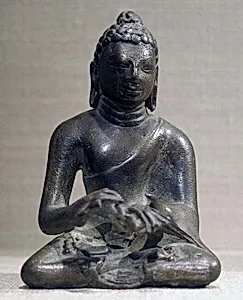
Seated Buddha
Unknown Artist
7th–8th century
Medium
Bronze
Dimensions
H. 3 7/8 in. (9.8 cm); Gr. W. 2 5/8 in. (6.7 cm); D. 2 1/8 in. (5.4 cm)
Classification
Sculpture
Culture & Period
Burma · Arakan period
Department
Asian Art
Museum
Metropolitan Museum of Art, New York, NY
Credit
Rogers Fund, 1968
Accession Number
68.116
Rights
Public Domain
Tags
Art Historical Context
This exquisite *Seated Buddha*, crafted in bronze during Burma's Arakan period (th–8th century captures the serene essence of Buddhist devotion in a remarkably intimate scale—standing just under 4 inches tall. Housed in the Metropolitan Museum of Art's Art Department, this sculpture from ancient Rakhine (formerly Arakan) reflects the region's early adoption of Theravada Buddhism, influenced by Indian and Southeast Asian traditions. Its compact dimensions (H. 3 7/8 in.; W. 2 5/8 in.; D. 2 1/8 in.) suggest it was likely a personal votive object, carried by pilgrims or used in private worship. The lost-wax casting technique typical of bronze sculptures from this era allowed for fine detailing, evident in the Buddha's calm meditative pose—likely in the earth-touching mudra, symbolizing enlightenment. Arakan, a coastal kingdom bridging India and Southeast Asia, flourished as a hub for Buddhist art, blending local motifs with Gupta-style iconography. Acquired through the Rogers Fund in 1968, this piece offers a window into pre-Pagan Myanmar's spiritual life, where such images inspired faith and meditation. Today, it reminds us of Buddhism's enduring spread across Asia, embodying peace amid the Arakan kingdom's dynamic history of trade and cultural exchange.