
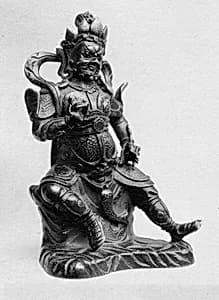
Seated Kubera
Unknown Artist
18th century
Medium
Bronze
Dimensions
H. 3 7/8 in. (9.8 cm); W. 2 3/4 in. (7 cm); D. 1 3/4 in. (4.4 cm)
Classification
Sculpture
Culture
Tibet
Department
Asian Art
Museum
Metropolitan Museum of Art, New York, NY
Credit
Fletcher Fund, 1924
Accession Number
24.174.5
Rights
Public Domain
Tags
Art Historical Context
This exquisite bronze sculpture, *Seated Kubera*,ails from 18th-century Tibet and captures the god of wealth in a compact, intimate form—standing just under 4 inches tall. Crafted by an unknown artist its small scale (H. 3 7/8 in.; W. 2 3/4 in.; D. 1 3/4 in.) suggests it was a personal devotional object, portable for private worship or carried by pilgrims. Acquired through the Fletcher Fund in 1924, it now graces the Asian Art department at the Metropolitan Museum of Art, exemplifying the refined metalwork traditions of Tibetan artisans. Kubera, revered in Tibetan Buddhism as Vaishravana—one of the Four Heavenly Kings—symbolizes prosperity, protection, and abundance. Seated in a posture of regal authority, the figure embodies the cultural fusion of Hindu and Buddhist iconography prevalent in Tibet during this era, when such sculptures served as talismans against misfortune and invocations for fortune. The bronze medium, achieved through skilled lost-wax casting, allowed for intricate details in drapery and posture, highlighting the technical mastery of Tibetan workshops. In the broader context of 18th-century Tibetan art, works like this reflect a golden age of religious sculpture amid monastic patronage, blending spiritual devotion with aesthetic elegance. Visitors will appreciate its serene presence, a timeless reminder of Tibet's rich cosmological heritage.