
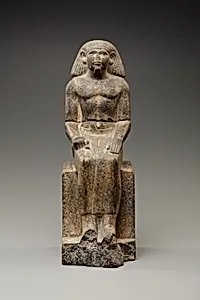
Seated statue of Kay
Unknown Artist
ca. 1950–1640 B.C.
Medium
Granodiorite
Dimensions
H. 24.5 cm (9 5/8 in.); W. 8 cm (3 1/8 in.); D. 12.5 cm (4 15/16 in.)
Classification
Seated statue of Kay
Period
Middle Kingdom
Department
Egyptian Art
Museum
Metropolitan Museum of Art, New York, NY
Credit
Rogers Fund, 1933
Accession Number
33.1.3
Rights
Public Domain
Tags
Art Historical Context
This seated statue of Kay, carved around 1950–1640 B.C. during Egypt's Middle Kingdom (Dyn 12–13), the poised dignity of a man in granodiorite, a tough, durable stone quarried from Aswan. Standing just 24.5 cm tall, the figure sits rigidly with hands on knees, embodying the idealized proportions and frontal gaze typical of Egyptian sculpture. Acquired by the Metropolitan Museum of Art through the Rogers Fund in 1933, it offers a window into the era's elite portraiture. In the Middle Kingdom, such statues often served funerary or votive purposes, housing the ka—the eternal spirit—ensuring the deceased's sustenance in the afterlife. Kay, likely a high-ranking official given the formal pose, reflects the period's artistic revival after the chaotic First Intermediate Period, blending realism with symbolic perfection. Granodiorite's resistance to weathering made it prized for enduring memorials, showcasing sculptors' mastery in undercutting details like folds in the kilt and muscular contours. Today, this compact masterpiece invites us to ponder ancient Egyptian beliefs in immortality, where stone outlasted flesh, preserving identity across millennia. A testament to the Middle Kingdom's cultural renaissance, it highlights how art bridged the living world and eternity.