
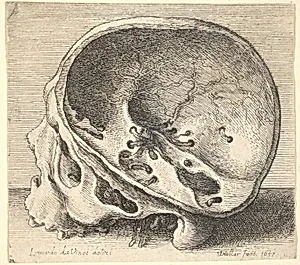
Sectioned skull in profile to left with the left side of the cranium removed
Medium
Etching: only state
Dimensions
Sheet: 2 5/8 × 2 15/16 in. (6.7 × 7.5 cm) cut slightly (c. 3mm) within platemark at sides
Classification
Prints
Department
Drawings and Prints
Museum
Metropolitan Museum of Art, New York, NY
Credit
Purchase, Joseph Pulitzer Bequest, 1917
Accession Number
17.50.18-103
Rights
Public Domain
Tags
Art Historical Context
This delicate etching, titled *Sectioned Skull in Profile to Left with the Left of the Cranium Removed captures Leonardo da Vinci's meticulous anatomical precision through the skilled hand of 17th-century engraver Wences Hollar. Created in 1651 as a single-state etching on a modest sheet measuring just 2 5/8 × 2 15/16 inches, it depicts a human skull sliced open to reveal internal structures, showcasing the Renaissance master's fascination with the body's mysteries. Leonardo, a pioneering anatomist, conducted clandestine dissections around 1510–1511, producing groundbreaking sketches that blended art and science during a time when such studies were revolutionary—and often taboo. Hollar, a Bohemian etcher renowned for his reproductive prints, faithfully translated Leonardo's drawing into this intricate print over a century later, preserving its scientific detail for wider audiences. The etching's fine lines and subtle shading highlight bone textures and cavities, exemplifying how printmaking democratized anatomical knowledge amid the Scientific Revolution. Housed in the Metropolitan Museum of Art's Drawings and Prints department (purchased via the Joseph Pulitzer Bequest in 1917), this work bridges art history and medicine, inviting visitors to marvel at humanity's quest to understand itself through Leonardo's visionary gaze.
About the Artist
Leonardo da Vinci|Wenceslaus Hollar · 1452–1519
Leonardo da Vinci (1452-1519) stands as the quintessential Renaissance polymath, whose genius spanned painting, sculpture, architecture, science, mathematics, engineering, anatomy, geology, cartography, botany, and writing. Born in Vinci, Italy, as the illegitimate son of a notary, Leonardo received limited formal education but demonstrated extraordinary artistic talent from an early age. His appr...