
青楼仁和嘉女芸者之部 唐人 獅子 角力|Seiro Niwaka Onna Geisha no Bu Tojin Shishi Sumo
ca. 1791
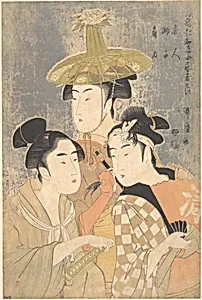
Medium
Woodblock print; ink and color on paper
Dimensions
H. 10 1/16 in. (25.6 cm); W. 15 1/8 in. (38.4 cm)
Classification
Prints
Culture & Period
Japan · Edo period (1615–1868)
Department
Asian Art
Museum
Metropolitan Museum of Art, New York, NY
Credit
H. O. Havemeyer Collection, Bequest of Mrs. H. O. Havemeyer, 1929
Accession Number
JP1667
Rights
Public Domain
Tags
Art Historical Context
In the vibrant world of Edo-period Japan (1615–1868), Kitagawa Utam's woodblock print *Seirō Niwaka Onna Geisha no Bu:jin Shishi Sumo* (ca. 1791) captures the playful spirit of the Yoshiwara pleasure district's festivals. Part of a series depicting *niwaka*—spontaneous disguises worn by courtesans and geisha during summer celebrations—this scene shows women transformed into burly Chinese wrestlers (*tojin*) locked in a mock lion sumo bout (*shishi sumo*). Adorned with elaborate hats and festive attire, they embody the "floating world" (*ukiyo-e*) of entertainment, blurring lines between gender, performance, and fantasy. Utamaro, a master of *bijin-ga* (pictures of beautiful women), elevates these figures with his signature finesse: delicate contours, subtle gradations of color via *bokashi* shading, and intricate patterns in silk kimonos and lion pelts. Printed in lush *nishiki-e* (brocade) style with multiple woodblocks for vibrant inks, the 10 x 15-inch sheet exemplifies ukiyo-e's technical brilliance and mass appeal. Donated to the Metropolitan Museum of Art from the H.O. Havemeyer Collection, it highlights Japan's golden age of printmaking, where art democratized glimpses of elite revelry for everyday viewers.
About the Artist
Kitagawa Utamaro · 1753–1806
Kitagawa Utamaro (c. 1753-1806) was one of the most celebrated masters of ukiyo-e woodblock printing, revolutionizing the art of bijin-ga (pictures of beautiful women) during Japan's Edo period. Born Kitagawa Ichitaro, his early life remains shrouded in mystery, with conflicting accounts placing his birth in Kyoto, Osaka, Yoshiwara in Edo (modern Tokyo), or Kawagoe in Musashi Province. Under the t...