
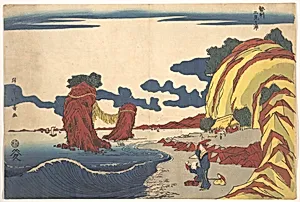
Seishu Futami ga Ura|View of Futami Beach at Ise
ca. 1810–1820
Medium
Woodblock print; ink and color on paper
Dimensions
Oban 10 x 15 in. (25.4 x 38.1 cm)
Classification
Prints
Culture & Period
Japan · Edo period (1615–1868)
Department
Asian Art
Museum
Metropolitan Museum of Art, New York, NY
Credit
Gift of Cole J. Younger, 1975
Accession Number
JP3493
Rights
Public Domain
Tags
Art Historical Context
Behold the serene yet dynamic *View of Futami Beach Ise* (Seishu Futami ga Ura), a captivating woodblock print by Shōtei Hokuju, around 1810–1820 during Japan's Edo period (1615–1868). This oban-sized work (10 x 15 in.), rendered in vibrant ink and color on paper exemplifies the ukiyo-e tradition—"pictures of the floating world"— celebrated everyday beauty and nature's fleeting moments. Hokuju, a-known but skilled printmaker active in Edo (modern Tokyo), specialized in landscapes and marine scenes, capturing the rhythm of waves and expansive seascapes with masterful precision. Futami Beach at Ise, a coastal gem near one of Japan's most sacred Shinto sites, the Ise Grand Shrine, served as a popular subject for pilgrims and artists alike. Hokuju's composition highlights crashing waves, sandy shores, and distant horizons, evoking the sublime power of the sea—a recurring motif in Edo-era prints that reflected Japan's island geography and spiritual reverence for nature. The woodblock technique allowed for bold colors and intricate details, produced through collaborative carving and printing processes that made such art accessible to a wide audience. Now housed in the Metropolitan Museum of Art's Asian Art Department (gift of Cole J. Younger, 1975), this print invites visitors to ponder the harmony of human observation and natural drama, a timeless hallmark of Japanese artistic ingenuity.
About the Artist
Shōtei Hokuju 昇亭北寿 (Japanese) · 1790 –1820
Japanese, active 1790–1820