
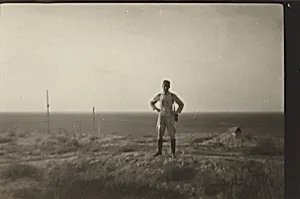
Self-Portrait at Front
c. 1915-1916
Medium
gelatin silver print
Dimensions
sheet: 6 x 8.9 cm (2 3/8 x 3 1/2 in.)
Classification
Photograph
Department
CPH
Museum
National Gallery of Art, Washington, D.C.
Credit
Gift of The André and Elizabeth Kertész Foundation
Accession Number
2000.170.3
Rights
Public Domain
Art Historical Context
André Kertész's *Self-Portrait at Front* (c. 1915-1916) captures a poignant moment from the artist's own experience during World War I. As a Hungarian photographer serving on the Eastern Front with the Austro-Hungarian army, Kertész turned his lens on himself amid the chaos of trench warfare. This intimate gelatin silver print, measuring just 6 x 8.9 cm, reflects the modest, portable photography of the era, allowing soldiers like him to document personal realities far from the grandeur of official war imagery. The medium—gelatin silver print—was a hallmark of early 20th-century photography, prized for its sharp detail and rich tonal range, which Kertész exploits to convey vulnerability and resilience. Though small in scale, the image exemplifies his emerging modernist sensibility: a direct, unadorned gaze that humanizes the soldier's life, foreshadowing his later innovations in composition and light. Housed in the National Gallery of Art's photography collection through a gift from The André and Elizabeth Kertész Foundation, this work offers visitors a rare glimpse into the personal side of global conflict, reminding us how one man's camera could pierce the fog of history.
About the Artist
André Kertész · 1894–1985
André Kertész, born Andor Kertész on July 2, 1894, in Budapest, Hungary, to a middle-class Jewish family, initially pursued a conventional path as a clerk at the Budapest Stock Exchange after graduating from the Academy of Commerce in 1912. Self-taught in photography after purchasing his first camera that year, he captured his early poetic visions of Hungarian landscapes and peasant life, includin...