
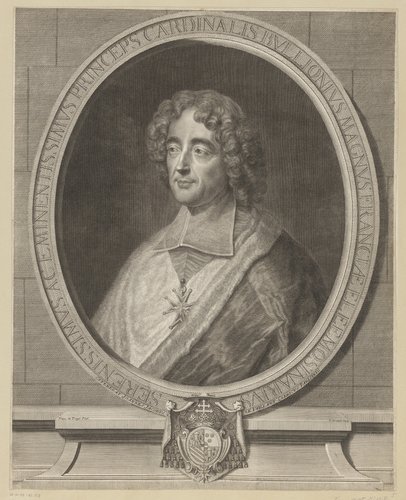
Serenissimus ac eminentissimus princeps cardinalis bullionius magnus Francae eleemosinarius
1673 - 1738
Medium
engraving
Dimensions
410; 511
Rights
Public Domain
About this artwork
blad: hoogte 511 mm (Binnen plaatrand afgesneden.) x breedte 410 mm (Binnen plaatrand afgesneden.)
Art Historical Context
Behold the majestic engraving *Serenissimus ac eminentissimus princeps cardinalis bullionius magnus Francae eleemosinarius* by Pierre Drevet (1673–1738), a master French engraver of the late Baroque era. This impressive portrait, measuring 511 mm high by 410 mm wide (trimmed within the plate marks), honors a lofty ecclesiastical figure: the "Most Serene and Most Eminent Prince Cardinal Bullionius Magnus, Grand Almoner of France." Created during France's grand siècle under Louis XIV, it captures the opulence and piety of the Catholic hierarchy, likely reproducing a painted original to immortalize the sitter's status. Drevet's virtuosity shines in his intricate engraving technique, where a copper plate is meticulously incised with fine lines to convey texture, shadow, and regal detail—from flowing robes to expressive features. Engravings like this were revolutionary, allowing high-quality reproductions to circulate beyond elite circles, democratizing access to aristocratic and religious iconography. This large-format print, with its precise burr and cross-hatching, exemplifies the French school's technical precision and dramatic chiaroscuro. Culturally, such works reinforced the intertwined power of Church and crown in 18th-century Europe, serving as both devotional aids and status symbols. Visitors, imagine this hanging in a noble salon, whispering tales of influence and faith amid Versailles' splendor. A testament to Drevet's legacy in portraiture, it invites us to ponder the enduring allure of engraved grandeur.