
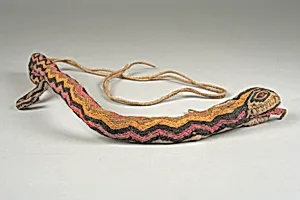
Serpent ornament
Unknown Artist
1450–1532 CE
Medium
Cotton, camelid hair
Dimensions
W. 1 × L. (includes tie) 34 in. (2.5 × 86.4 cm)
Classification
Textiles-Woven
Culture
Inca (?)
Department
Arts of Africa, Oceania, and the Americas
Museum
Metropolitan Museum of Art, New York, NY
Credit
Bequest of Arthur M. Bullowa, 1993
Accession Number
1994.35.113
Rights
Public Domain
Tags
Art Historical Context
This exquisite **Serpent Ornament**, woven from cotton and camelid hair (likely alpaca or llama wool), dates to Inca Empire's flourishing period (1450–2 CE). Measuring just 1 inch wide and 34 inches long including its tie, this delicate textile exemplifies the Incas' mastery of weaving, a craft central to their society. Produced in the Andes, where such fibers provided exceptional durability and vibrant dyes, it served possibly as a ceremonial accessory, amulet, or elite adornment, reflecting the culture's reverence for finely crafted textiles as symbols of status and spirituality. The serpent motif, a recurring theme in Andean art, evokes powerful associations with fertility, water, and underworld forces—elements vital to Inca cosmology amid their mountainous terrain. Woven in intricate supplementary-weft techniques, the design showcases the technical prowess of Inca weavers, who could produce complex patterns on backstrap looms without European influences. Though attributed tentatively to the Inca, its style aligns with pre-Columbian traditions just before Spanish conquest in 1532. Today, this rare piece graces the Metropolitan Museum of Art's Department of Arts of Africa, Oceania, and the Americas, a bequest from Arthur M. Bullowa in 1993. It invites us to marvel at how textiles bridged the everyday and the divine in Inca life, preserving cultural narratives in thread.