
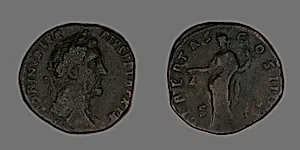
Sestertius (Coin) Portraying Emperor Antoninus Pius
155-156
Medium
Bronze
Dimensions
Diam.: 3.2 cm (1 5/16 in.)
Classification
coin
Department
Arts of Greece, Rome, and Byzantium
Museum
Art Institute of Chicago
Accession Number
141706
Rights
Public Domain
About this artwork
The front (obverse) of this coin portrays the head of Emperor Antoninus Pius, facing to the right. The back (reverse) depicts the deity Libertas (Liberty) standing front, with head to the left. Her left hand rests on a sceptre and her right hand holds a pileus (cap).
Art Historical Context
This bronze sestertius, struck around 155-156 CE during the reign of Emperorinus Pius, exemplifies the artistry and propaganda of ancient Rome. Measuring just 3.2 cm in, it features a detailed portrait of the emperor on the obverse—likely laureate and togate—symbolizing his authority piety, for which he earned the epithet "Pius." reverse typically celebrated imperial virtues, deities like Pax or Concordia, or public works, reinforcing Rome's stability in an era of relative peace following the expansive reigns of Trajan and Hadrian. As a large-denomination coin, the sestertius was a workhorse of Roman economy, used for everyday transactions and state payments. Minted in high relief through die-striking techniques, its intricate engravings captured realistic facial features and dynamic drapery, showcasing Roman mastery of portraiture that blended Greek idealism with imperial realism. These coins doubled as portable billboards, disseminating the emperor's image across the vast empire. Housed in the Art Institute of Chicago's Arts of Greece, Rome, and Byzantium department, this piece offers a tangible glimpse into Antoninus Pius's benevolent rule (138-161 CE), a "golden age" of prosperity before the Antonine Plague. It reminds us how even humble currency preserved history's grandeur.
About the Artist
Ancient Roman
The artists attributed to "Ancient Roman" in museum collections represent the anonymous craftsmen who produced the vast output of sculpture, frescoes, mosaics, and reliefs defining Roman visual culture from the Republic (c. 509–27 BCE) to the late Empire (c. 395 CE). Individual identities remain elusive, as Roman makers were typically viewed as skilled tradesmen—often enslaved Greeks or provincial...