
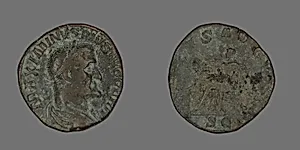
Sestertius (Coin) Portraying Emperor Maximinus
235-236
Medium
Bronze
Dimensions
Diam.: 3 cm (1 3/16 in.)
Classification
coin
Department
Arts of Greece, Rome, and Byzantium
Museum
Art Institute of Chicago
Accession Number
141801
Rights
Public Domain
Art Historical Context
Step into the turbulent world of the Roman Empire's Crisis of the Third Century with bronze sestertius coin, struck during the brief reign of Emperor Maximin Thrax (r. 235–238 CE). just 3 cm in diameter, thisassuming artifact from the Art Institute of Chicago Arts of Greece, Rome and Byzantium collection boldly portrays Maximinus, a towering soldier-emperor of Thracian origins who rose from the ranks to seize power after assassinating his predecessor, Severus Alexander.ed in 235–236 CE, it exemplifies Roman imperial coinage, where the obverse typically features the emperor's laureate portrait—radiating authority and divine favor—while the reverse likely honors military victories or deities, reinforcing his legitimacy amid civil strife. Crafted through intricate die-stamping techniques, the coin's detailed relief captures Maximinus' stern visage with realistic vigor, a hallmark of late Roman portraiture blending idealism and individuality. Sestertii like this were everyday currency, circulating widely to proclaim the emperor's image across the vast empire, serving as portable propaganda that unified loyalty and economy. As one of the first "barracks emperors," Maximinus' coins mark a shift toward militarized rule, foreshadowing decades of instability. This tiny bronze survivor offers a tangible glimpse into an era when power hung by a thread—and a coin.
About the Artist
Ancient Roman
The artists attributed to "Ancient Roman" in museum collections represent the anonymous craftsmen who produced the vast output of sculpture, frescoes, mosaics, and reliefs defining Roman visual culture from the Republic (c. 509–27 BCE) to the late Empire (c. 395 CE). Individual identities remain elusive, as Roman makers were typically viewed as skilled tradesmen—often enslaved Greeks or provincial...