
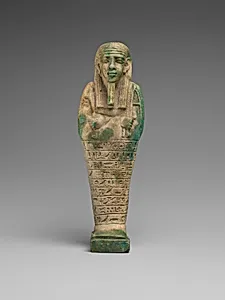
Shabti of Wahibremhebyt, son of Isetweret
Unknown Artist
570–526 B.C.
Medium
Faience
Dimensions
H. 13.2 × W. 4.3 × D. 3 cm (5 3/16 × 1 11/16 × 1 3/16 in.)
Classification
Shabti, Wahibremhebyt
Period
Late Period (Saite)
Department
Egyptian Art
Museum
Metropolitan Museum of Art, New York, NY
Credit
Museum Accession
Accession Number
O.C.875
Rights
Public Domain
Art Historical Context
Step into the mystical world of ancient Egyptian afterlife beliefs with the *Shabti of Wahibremhebyt, son of Isetweret*, a delicate faience figurine from Egypt's Late Period (Dynasty 26, ca. 570–526 B.C.). Crafted during the Saite era, a time of artistic revival echoing Old Kingdom grandeur, this small servant figure (just 13.2 cm tall) was designed to magically activate in the tomb, performing laborious tasks for its owner in the eternal realm—freeing the deceased soul for a life of leisure. Made of faience—a composite of quartz, lime, and clay fired with a vibrant turquoise glaze—this medium was prized for its luminous, jewel-like quality, evoking the fertile Nile and rebirth. Shabtis like this one often bear inscriptions with spells from the *Book of the Dead*, commanding them to "work for" their master. Wahibremhebyt, son of Isetweret, was likely a person of means, as such finely detailed tomb servants were status symbols for elites. Housed in the Metropolitan Museum of Art's Egyptian Art collection, this shabti exemplifies the Saite period's technical mastery and spiritual devotion, bridging the mortal world and eternity in a single, enchanting form.