
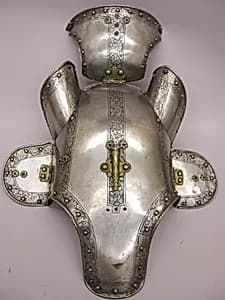
Shaffron (Horse's Head Defense)
Unknown Artist
ca. 1545
Medium
Steel, brass, leather
Dimensions
H. 16 3/8 in. (41.6 cm); W. 11 1/4 in. (28.6 cm); D. 9 1/4 in. (23.5 cm); Wt. 4 lb. 2.7 oz. (1890.9 g)
Classification
Equestrian Equipment-Shaffrons
Culture
German
Department
Arms and Armor
Museum
Metropolitan Museum of Art, New York, NY
Credit
Gift of William H. Riggs, 1913
Accession Number
14.25.1659
Rights
Public Domain
Art Historical Context
Step into the world of 16th-century with this striking German shaffron, a protective head defense for warhorses dating to around 1545. Crafted for the battlefield or tournament jousts, it shielded the horse's vulnerable face from lances, swords, and, underscoring the vital role of cavalry in Renaissance Europe. Now housed in the Metropolitan Museum of Art Arms and Armor Department—thanks to a 1913 gift from William H. Riggs piece exemplifies the era's fusion of function and formidable design. Made from robust steel reinforced with brass and secured by leather straps, the shaffron measures just over 16 inches high and weighs a sturdy 4 pounds, balancing protection with the horse's mobility. German armorers of the time were masters of embossing and riveting, creating form-fitting plates that contoured to the animal's skull while allowing vision and breathing. Its compact dimensions highlight the precision engineering needed for equestrian gear, where every ounce mattered in the chaos of combat. This artifact reveals the cultural prestige of mounted knights, where equipping horse and rider alike was a mark of wealth and status. Though by an unknown artisan, it stands as a testament to Germany's leadership in plate armor innovation during the Reformation era, inviting us to imagine thundering hooves on misty fields long past.