
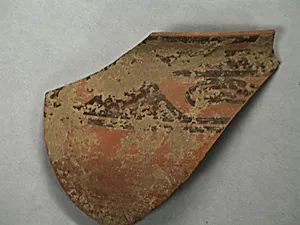
Shard
Unknown Artist
ca. 4th–5th century
Medium
Painted terracotta
Dimensions
H. 2 1/2 in. (6.4 cm); W. 3 1/2 in. (8.9 cm); D. 3/4 in. (1.9 cm)
Classification
Ceramics
Culture
Pakistan
Department
Asian Art
Museum
Metropolitan Museum of Art, New York, NY
Credit
Seymour Fund, 1992
Accession Number
1992.271.31
Rights
Public Domain
Tags
Art Historical Context
This delicate shard of painted terracotta, hailing from the Gandhara region of ancient Pakistan around the 4th–5th century CE, offers a glimpse into the vibrant ceramic traditions of early South Asian art. Measuring just 2½ inches high and 3½ inches wide, this fragment—acquired by the Metropolitan Museum Art through the Seymour Fund in 199—likely once formed part of a larger vessel, plaque, or architectural element. Its classification as ceramics within the Asian Art department underscores region's longstanding mastery of fired clay, a durable medium prized for both everyday use and ritual objects. Gandhara, a cultural crossroads along the Silk Road, blended Hellenistic influences from Alexander the Great's legacy with indigenous Indian and Buddhist motifs, fostering innovative artistic expressions. Though the artist remains unknown, the painted surface hints at skilled techniques in pigmentation and firing, where mineral-based colors were applied before or after glazing to withstand time. Such shards illuminate daily life and devotional practices in a era of Kushan and post-Kushan prosperity, where terracotta served as an accessible canvas for storytelling and symbolism. Today, this unassuming piece invites us to ponder the fragility of history—preserved against odds, it connects us to artisans whose hands shaped a multicultural world over 1,500 years ago.