
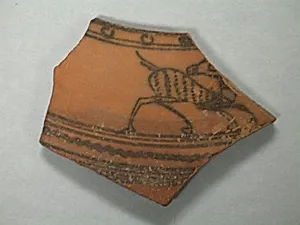
Shard with Figural Decoration
Unknown Artist
ca. 4th–5th century
Medium
Painted terracotta
Dimensions
3 1/4 x 4 1/8 in. (8.3 x 10.5 cm)
Classification
Ceramics
Culture
Pakistan
Department
Asian Art
Museum
Metropolitan Museum of Art, New York, NY
Credit
Gift of Joseph G. Gerena, in memory of Anthony Gardner, 1992
Accession Number
1992.251.5
Rights
Public Domain
Tags
Art Historical Context
This delicate shard of painted terracotta, hailing from the Gandhara region of ancient Pakistan around the 4th–5th century, offers a glimpse into the vibrant artistic traditions of this crossroads culture. Gandhara, spanning modern-day Pakistan and Afghanistan, was a pot of Greek, Persian, and Indian influences following Alexander the Great's conquests, famed for its Greco-Buddhist sculptures Though this fragment comes from an unknown artist, its survival as a piece of everyday ceramics underscores the widespread use of terracotta in and temples. Measuring just 3¼ x 4⅛ inches, the shard features figural decoration likely depicting animals, a common motif in Gandharan art symbolizing fertility, protection, or narrative scenes from daily life and mythology. The painting technique—applying pigments to fired clay—highlights skilled craftsmanship, where colors were chosen for durability against wear. Such shards were often parts of larger vessels used for storage or ritual purposes. On view in the Metropolitan Museum of Art's Asian Art department (gift of Joseph G. Gerena, 1992), this artifact reveals the artistic ingenuity of Gandhara's potters, bridging elite sculpture with humble pottery. It invites us to ponder the lives of those who crafted and used it, preserving a fragment of ancient South Asian heritage.