
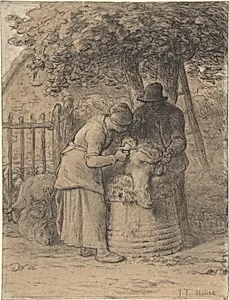
Sheepshearing Beneath a Tree
ca. 1854
Medium
Conté crayon with stumping, heightened with pen and brown ink and white gouache on wove paper
Dimensions
11 5/8 x 8 7/8 in. (29.5 x 22.5 cm)
Classification
Drawings
Department
Drawings and Prints
Museum
Metropolitan Museum of Art, New York, NY
Credit
Gift of Miss G. Louise Robinson, 1940
Accession Number
40.12.3
Rights
Public Domain
Tags
Art Historical Context
Jean-François Millet's *Sheepshearing Beneath a Tree* (ca. 1854) captures a timeless moment of rural labor in mid-19th-century France A leading figure of the Realist movement and the Barbizon School, celebrated the dignity of peasant life, turning everyday scenes like this communal sheepshearing—depicting men and women working together with their flock under a shady tree—into profound statements on human endurance and harmony with nature. Created during a period of rapid industrialization, the drawing reflects Millet's commitment to portraying the unvarnished beauty of agricultural toil, distancing himself from the romanticized ideals of earlier art. This intimate study, measuring 11 5/8 x 8 7/8 inches, showcases Millet's masterful command of mixed media on wove paper: Conté crayon blended with stumping for soft, atmospheric modeling; precise pen and brown ink lines for definition; and white gouache heightening to evoke sunlight filtering through leaves. Such techniques allowed Millet to achieve remarkable depth and luminosity in a preparatory drawing, likely exploring compositions for larger paintings. Housed in the Metropolitan Museum of Art's Department of Drawings and Prints (gift of Miss G. Louise Robinson, 1940), it invites visitors to appreciate the quiet poetry in ordinary labor.
About the Artist
Jean-François Millet · 1814–1875
Jean-François Millet (1814-1875) was a French painter and one of the founders of the Barbizon school, whose dignified depictions of peasant laborers transformed how art could represent rural life. His monumental images of sowers, gleaners, and field workers elevated common people to subjects previously reserved for mythological or historical figures, making him a pivotal figure in the development ...