
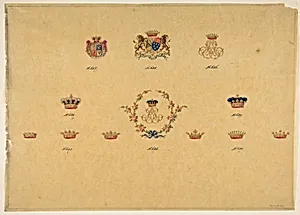
Sheet of Monogram Designs
19th century
Medium
Pen and blue ink, watercolor, gouache, and gold gilt
Dimensions
sheet: 9 11/16 x 13 9/16 in. (24.6 x 34.4 cm)
Classification
Drawings
Department
Drawings and Prints
Museum
Metropolitan Museum of Art, New York, NY
Credit
The Elisha Whittelsey Collection, The Elisha Whittelsey Fund, 1953
Accession Number
53.675.32
Rights
Public Domain
Tags
Art Historical Context
This exquisite *Sheet of Monogram Designs created by an anonymous French artist in the19th century, showcases a collection of intricately intertwined initials, evoking the elegance of personal heraldry. Rendered on a generous sheet measuring 9 11/16 x 13 9/16 inches, the work employs pen and blue ink for precisework, layered with vibrant watercolor and opaque gouache for depth and color, and finished with shimmering gold gilt that catches the light like fine jewelry. Housed in Metropolitan Museum of Art's Drawings and Prints department as part of The Elisha Whitt Collection (acquired through the Elisha Whittelsey Fund in 1953), it exemplifies the artistry of anonymous draftsmen who crafted bespoke designs. In 19th-century France, monograms were symbols of identity and status, often adorning linens, silverware, stationery, or even coats of arms for the rising bourgeoisie and nobility. This sheet likely served as a pattern book or proposal for customization, highlighting the era's fascination with personalization amid industrialization. The luxurious materials—especially the gold gilt—underscore the cultural value placed on opulent, hand-embellished decoration, blending technical precision with decorative flair. A charming window into everyday luxury, it reminds us how art elevated the intimate details of life.
About the Artist
Anonymous, French, 19th century · 1800–1900
**Anonymous, French, 19th Century (ca. 1800–1900)** The artist cataloged as Anonymous, French, 19th century embodies the enigmatic yet essential contributions of unidentified creators to France's vibrant 19th-century art world. Active roughly between 1800 and 1900, this figure—or potentially collective workshop—produced a diverse array of works amid the nation's transition from Neoclassicism thro...