
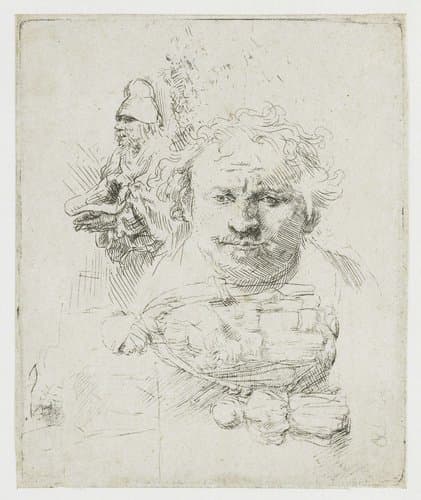
Sheet of studies with the head of the artist, a beggar man, woman and child
Medium
etching
Dimensions
112; 92
Rights
Public Domain
About this artwork
opschrift, verso midden onder, pen in bruin: ‘338 (doorgestreept) en 337’ Gersaint nummer
Art Historical Context
In 1651, Rembrandt van Rijn, the eminent Dutch artist of the Golden Age, created this intimate *Sheet of studies with the head of the artist, a beggar man, woman and child*. Measuring just 112mm by 92mm, this etching exemplifies Rembrandt's mastery of the medium during his mature period in Amsterdam. Etching allowed him to experiment with intricate lines and tonal gradations, often refining plates through multiple states to achieve profound depth and luminosity—techniques that elevated printmaking to fine art status. The sheet captures a diverse array of human figures: Rembrandt's own expressive self-portrait head, alongside a ragged beggar man, a woman, and a child. These rapid studies reflect his lifelong fascination with the human condition, blending self-observation with empathy for everyday people, possibly drawn from Amsterdam's bustling streets. Such sketches served as preparatory work for larger paintings or standalone gems, showcasing his unparalleled ability to convey character and emotion in miniature scale. Catalogued by 18th-century connoisseur Gersaint with numbers 337 and 338 inscribed on the verso, this work underscores Rembrandt's enduring legacy in printmaking. Visitors will appreciate its raw vitality, a window into the artist's innovative process amid the vibrant cultural life of 17th-century Holland.
About the Artist
Rembrandt van Rijn · 1606–1669
Rembrandt Harmenszoon van Rijn (1606–1669) stands as one of the greatest visual artists in the history of Western art and the most important Dutch painter of the 17th century. Born in Leiden to a prosperous miller's family, Rembrandt transformed painting through his revolutionary use of light and shadow, his psychological depth in portraiture, and his elevation of etching to a fine art. His approx...