
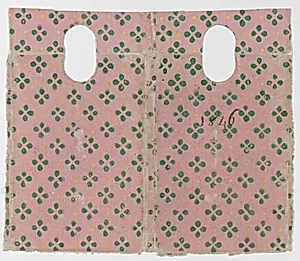
Sheet with an overall floral and dot pattern
ca. 1836
Medium
Relief print (wood or metal)
Dimensions
Sheet: 5 3/16 × 6 1/8 in. (13.1 × 15.6 cm)
Classification
Prints
Department
Drawings and Prints
Museum
Metropolitan Museum of Art, New York, NY
Credit
Harris Brisbane Dick Fund, 1940
Accession Number
39.13.239
Rights
Public Domain
Art Historical Context
This delicate sheet, featuring an overall floral and dot pattern, is a example of anonymous 19th-century printmaking from around 1836. Created as a relief print—likely from a wood or metal block—this small work (just 5 3/16 × 6 1/8 inches) captures the era's fascination with intricate, repeating motifs inspired by nature. Such patterns were staples in decorative arts, adorning textiles, wallpapers, and book covers during the early industrial age. Relief printing, the technique used here, involved carving away the non-printing areas of a block, inking the raised surface, and pressing it onto paper. Wood offered organic warmth, while metal provided durability for high-volume production—a practical innovation as mechanized printing revolutionized design accessibility. Acquired through the Harris Brisbane Dick Fund in 1940, this piece resides in The Metropolitan Museum of Art's Drawings and Prints department, highlighting everyday artistry often overlooked in favor of grand paintings. Though anonymous, the sheet reflects broader cultural tastes of the 1830s, when floral motifs symbolized abundance and elegance in domestic spaces. Its preservation offers visitors a glimpse into the unsung craft behind Victorian-era aesthetics, blending utility with subtle beauty.
About the Artist
Anonymous
In the vast tapestry of art history, "Anonymous" stands not as a singular individual but as a collective designation for countless unidentified creators whose works have endured across millennia. These artists, spanning prehistoric cave painters to medieval illuminators and folk craftsmen, produced the foundational layers of human visual culture. Prior to the Renaissance, when individual fame emer...