
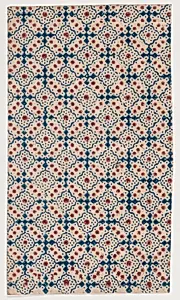
Sheet with an overall pattern of dots and squares
19th century
Medium
Relief print (wood or metal)
Dimensions
Sheet: 4 5/16 × 7 1/2 in. (10.9 × 19.1 cm)
Classification
Prints
Department
Drawings and Prints
Museum
Metropolitan Museum of Art, New York, NY
Credit
The Elisha Whittelsey Collection, The Elisha Whittelsey Fund, 1948
Accession Number
48.142.76
Rights
Public Domain
Art Historical Context
This delicate 19th-century relief print, titled *Sheet with an Overall Pattern of Dots and Squares*, showcases the artistry of anonymous craftsmanship through its repetitive geometric motif. Created using a wood or metal block—a traditional relief printing technique where ink adheres only to raised surfaces—the small sheet (4 5/16 × 7 1/2 in.) repeats dots and squares in a harmonious, all-over design. Such patterns were emblematic of the era's growing fascination with textiles, wallpapers, and decorative arts, where precise repetition could transform humble materials into elegant backdrops for everyday life. In the 19th century, relief printing flourished amid the Industrial Revolution, bridging handmade traditions with emerging mass production. This anonymous example, preserved in The Metropolitan Museum of Art's Drawings and Prints department, highlights the technical ingenuity required to achieve crisp, uniform impressions on a modest scale. Likely a pattern sample for fabric or paper hangings, it reflects broader cultural shifts toward affordable ornamentation in Victorian homes. Acquired through The Elisha Whittelsey Collection in 1948, this print invites visitors to appreciate the subtle beauty of functional design. Up close, the interplay of dots and squares reveals the printer's skill, reminding us how simple forms can evoke rhythm and infinity.
About the Artist
Anonymous
In the vast tapestry of art history, "Anonymous" stands not as a singular individual but as a collective designation for countless unidentified creators whose works have endured across millennia. These artists, spanning prehistoric cave painters to medieval illuminators and folk craftsmen, produced the foundational layers of human visual culture. Prior to the Renaissance, when individual fame emer...