
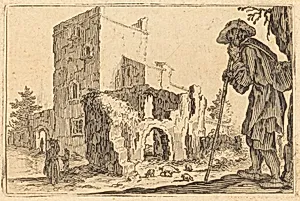
Shepherd and Ruins
c. 1622
Medium
etching on laid paper
Dimensions
plate: 5 × 7.7 cm (1 15/16 × 3 1/16 in.) sheet (irreg.): 9 × 13.4 cm (3 9/16 × 5 1/4 in.)
Classification
Department
CG-E
Museum
National Gallery of Art, Washington, D.C.
Credit
Rosenwald Collection
Accession Number
1949.5.152
Rights
Public Domain
Art Historical Context
In the intimate etching *Shepherd and Ruins created around 1622 by French master printmaker Jacques Callot, lone shepherd tends his flock amid crumbling ancient architecture. Measuring just 5 × 7.7 cm on the plate, this delicate work exemplifies Callot's genius for the minuscule, transforming laid paper into a window on a poetic, melancholic world. Etching, Callot's preferred medium, allowed him to incise fine, intricate lines with a needle into a wax-coated copper plate, yielding unprecedented detail and tonal subtlety—revolutionary for early 17th-century printmaking. Callot, a pivotal figure in the transition from Mannerism to Baroque art, drew from his travels in Italy, where he absorbed classical ruins and pastoral ideals. This print likely evokes the *locus amoenus* tradition, blending serene rural life with the grandeur and decay of antiquity, symbolizing time's passage and human transience. Produced during Callot's prolific Nancy period, it reflects the era's fascination with landscape as moral allegory, bridging courtly elegance and emerging realism. Housed in the National Gallery of Art's Rosenwald Collection (Department CG-E), *Shepherd and Ruins* invites visitors to ponder eternity through its tiny scale—proof that profound beauty thrives in the miniature.
About the Artist
Jacques Callot · 1592–1635
Jacques Callot (1592–1635) was a French printmaker and draftsman from the Duchy of Lorraine, widely regarded as one of the first great artists to practice the graphic arts exclusively. His more than 1,400 etchings chronicled the breadth of 17th-century life, from Medici court festivities to the brutal realities of warfare. Callot revolutionized etching through technical innovations including the é...