
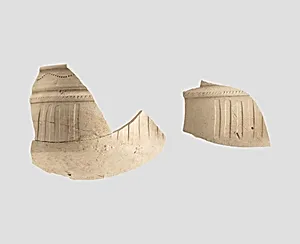
Sherd
Unknown Artist
ca. 3100–2700 BCE
Medium
Ceramic
Dimensions
3.09 x 3.63 in. (7.85 x 9.22 cm)
Classification
Ceramics-Vessels
Period
Ninevite V
Department
Ancient Near Eastern Art
Museum
Metropolitan Museum of Art, New York, NY
Credit
Purchase, Colt Archaeological Institute Inc. Gift, 1985
Accession Number
1985.61.1a, b
Rights
Public Domain
Art Historical Context
This delicate ceramic sherd, dating to around 3100–2700 BCE, offers a glimpse into the Ninevite V period of ancient northern Mesopotamia—modern-day Iraq. Measuring just 3.09 x 3.63 inches, it is a fragment of a larger vessel, unearthed from a time when early urban communities were emerging at sites like Nineveh. part of the Metropolitan Museum of Art’s Ancient Near Eastern Art collection it was acquired through a 1985 purchase and gift from the Colt Archaeological Institute, highlighting the role of dedicated excavations in preserving these artifacts. Sherds like this one are invaluable to archaeologists, revealing the pottery-making techniques, trade networks, and daily life of prehistoric peoples. During the Ninevite V phase, ceramics represented a key technological advancement, with potters firing clay to create durable vessels for storage, cooking, and rituals. Though small, this piece embodies the ingenuity of an era bridging the late Neolithic and early Bronze Age, when distinctive regional styles began to flourish. Step closer to imagine the hands that shaped it millennia ago—each sherd a quiet storyteller of forgotten worlds.